The clip in 5 parts, it is from the "TV Broadcast of the entire "Ever-victorious Workers' Party of Korea" held at the May Day Stadium in Pyongyang, North Korea on September 4, 2001."
Part 1
Part 2
Part 3
Part 4
Part 5
Part 6
---
1) For how this works see State of the Mind clip here
2) Older clips here
---
Military band performance 9/9/2003 (55th DPRK anniversary)
Military band performance 4/25/2002 (70th People's Army anniversary - the army was founded 19 years before the government?)
Showing posts with label DPRK. Show all posts
Showing posts with label DPRK. Show all posts
Tuesday, November 21, 2006

Saturday, November 4, 2006
North Korea Karaoke
Enjoy! (too bad I don't read Korean - appreciate if anyone translate the titles)
Don't ask my name
A Whistle
Air Koryo
Unification Rainbow
Don't ask my name
A Whistle
Air Koryo
Unification Rainbow
Tuesday, October 17, 2006
Kim Jong-il: second test or bluff again?
There has been report that N Korea is going to conduct its "second" nuclear test soon, right after the "first" (alleged) test and today again, apparently the evidence was that some trucks were spotted around the Punggye site.
I maintain my skepticism on the technological capability of KJI's highly isolated team. Unlike the Indian and the Pakistani in 1998, or even the Chinese in 1964, N Korea scientists were isolated for more than half a decade from the rest of the world (except for a Soviet aided small facility in Yangban since mide 1960s, which is mainly for preaceful use). The Chinese team, when the research started in late 1950s, was only isolated for less than 10 years, with a few top scientists educated and worked in top US facilities. The Chinese also has a much larger talent pool, given its population then of 600M vs 22M of DPRK today.
My skepticism was confirmed when the test on October 9 turned out to be either a fizzle or fake. Even with the recent detection of radioactive sources by US reconnaissance, NK could have faked the radioactive elements as well, if it chose to do so. A small amount of waste from power plant would generate a large enough sample to fake the radioactive traces if it was indeed a chemical explosion. Although my personal opinion is that to fake a 500 ton equivalent blast is a non-trivial task which involves the simultaneous detonation of many tonnes of explosives (may be much smaller than 500 as it could be non-TNT, but should be near the 100 nevertheless), and I think it is probably more challenge for KJI to fake the blast.
I am more skeptical of the speculation of a second test, for the following reasons
I maintain my skepticism on the technological capability of KJI's highly isolated team. Unlike the Indian and the Pakistani in 1998, or even the Chinese in 1964, N Korea scientists were isolated for more than half a decade from the rest of the world (except for a Soviet aided small facility in Yangban since mide 1960s, which is mainly for preaceful use). The Chinese team, when the research started in late 1950s, was only isolated for less than 10 years, with a few top scientists educated and worked in top US facilities. The Chinese also has a much larger talent pool, given its population then of 600M vs 22M of DPRK today.
My skepticism was confirmed when the test on October 9 turned out to be either a fizzle or fake. Even with the recent detection of radioactive sources by US reconnaissance, NK could have faked the radioactive elements as well, if it chose to do so. A small amount of waste from power plant would generate a large enough sample to fake the radioactive traces if it was indeed a chemical explosion. Although my personal opinion is that to fake a 500 ton equivalent blast is a non-trivial task which involves the simultaneous detonation of many tonnes of explosives (may be much smaller than 500 as it could be non-TNT, but should be near the 100 nevertheless), and I think it is probably more challenge for KJI to fake the blast.
I am more skeptical of the speculation of a second test, for the following reasons
- NK only has limited amount of Plutonium. Of the amount (US estimated by US intelligence) equivalent of 4-10 bombs (I tend to believe the low side limit), one is already gone (even if it is a fizzle, NK should have used the amount for one full bomb and the rest of the Plutonium are forever wasted and buried under Mantapsan). NK cannot afford to waste another 2 kilo's of Pu on a second test.
Although NK has uranium mines, the alleged bomb is believed to be Plutonium based. Suffice it to say that the Plutonium enrichment and explosion technology is significantly different from that of Uranium and that it is non-trivial to enrich the required material even if NK has natural uranium mines -- (update) Experts said the use of plutonium to make the bomb was important because it suggested that North Korea probably had only one nuclear program mature enough to produce weapons."This is good news because we have a reasonably good idea of how much plutonium they have made," said Siegfried Hecker, the former head of the Los Alamos National Laboratory and now a visiting professor at Stanford University. - Whether the blast on October 9 was a fizzle or a success (if not fake), a sensible approach would be to thoroughly analyze the data before conducting the second test. With the dated computational technological in NK, it is unlikely for it to gain new knowledge by testing a second bomb until at least 0.5-1 year later
- As many have suspected, the October 9 blast serves more as a political statement (and diplomatic gesture), in KJI's weird mind, than a technological demonstration. I do not see any incremental impact a second test could have served him. Instead, if the second test fails again, it would be immense embarrassment for Kim. (the first test could still be called a success since the chain reaction did started, even though it did not sustain. But if the second test turns out to be a fizzle again, then it certainly covers no new ground)
I was, of course, trying to reason with KJI. As we know, rationality does not necessarily go with his mind. If I am wrong, do not blame me, it just proves KJI is more insane than we have thought.
Monday, October 9, 2006
North Korea Test not really a success
Many scientists now believe that the infamous Kim Jong-il fart may not be such a success as claimed. It is more likely a weaker version of the ad hoc test conducted by Pakistan as a response to India's test in 1998.
There are a few possible reasons for coming to such deduction
UPDATE (Oct10): Armscontrol Wonk is more adamant that it was a clear failure. I think he is right. More discussion on the likelihood of a failed test/hoax here.

There are a few possible reasons for coming to such deduction
- DPRK does not have a lot of purified Plutonium or Uranium, to conserve nuke material it had to conduct a mini-test
- The technology may be immature -- e.g. the fuel (purity) grade is barely good for an explosion, but far from the optimum energy of a successful test (the consequence of this case would be dreadful for environmentalist, as a lot of unreacted nuke materials might have been left in the tunnel)
- The detonation process, though quite simple, still requires certain engineering precision, which the outdated NK technology may not have mastered
- The failure to seek attention might have prompted KJI to force a pre-mature test -- as happened for Taepodong-2 in July
- "Gary Gibson, senior seismologist at Australia's Seismology Research Center, said a 4.2 magnitude quake would be the result of a one kiloton explosion"
- This is small even if one allows for the margin of error, because "The nuclear weapon the United States exploded over Hiroshima in 1945 produced a 12.5-kiloton yield.
- A successful test would be one like what India did, with an average of 12 kilton/test. "In 1998, India carried out five underground nuclear tests at Pokharan in the western desert state of Rajasthan and declared itself a nuclear weapons state. The total yield of the first round of blasts measured near 60 kilotons...."Our biggest one was in the vicinity of 45 kilotons. That was thermo-nuclear," said S.K. Malhotra, head of the public awareness division of the Department of Atomic Energy.."
- Nuclear analyst Andrew Davies, from the Australian Strategic Policy Institute, said if the North Korean test yield was only a kiloton, Pyongyang may be disappointed..."A kiloton is a very low yield and would tend to suggest, I would have thought, that the device was not all they hoped it would be," Davies told Reuters. "If a nuclear, plutonium bomb fizzles, you can still get one or two kilotons quite easily. You still get a significant energy release. But an efficient device will give you more like 20 (kilotons)."
- Even the less successful (conducted without proper preparation) test by Pakistan, was believed to have generated at least 9-12 kilotons in strength. "Pakistan said two nuclear tests had a total yield of between 34-48 kilotons, while three others were sub-kiloton. It said a sixth test yielded 10-15 kilotons. The Southern Arizona Seismic Observatory said the two major tests yielded 9-12 kilotons, while the sixth yielded only 4-6 kilotons."
- "Although details are tentative, initial and unconfirmed South Korean reports indicate that the test was a fission device with a yield of .55 kT. By comparison the nuclear bomb that was dropped on Hiroshima yielded approximately 12.5 kT. The figure of .55 kT, however, seems too low given the 4.2 register on the Richter scale. This could suggest - depending upon the geological make-up of the test site - a yield of 2-12 kT. If, however, the lower yield is correct, it would suggest that the test had been a "pre- or post-detonation" event (ie a failure), as it had been anticipated that North Korea's first nuclear test would have a significantly higher yield."
UPDATE (Oct10): Armscontrol Wonk is more adamant that it was a clear failure. I think he is right. More discussion on the likelihood of a failed test/hoax here.
North Korea nuclear test information
Update (10/10):
Global security has a few satellite pictures showing the entrance of the Punggye-yok tunnel
(update 10/12, H-T commentator luistxo for google location tags, and from there a previous post by armscontrolwonk)

north-korea tagged map by user - Tagzania
I am not sure exactly where it is located, but I found a couple suspicious buildings a few hundred meters east of the epicenter, at 41.309438E,129.19365N

north-korea tagged map by user - Tagzania
---

Google map links here. DPRK map here, the site is north of Chunhyung-ri (春兴里), or 17 km NNW of the train station Punggye-yok (豐溪驿) and just a few km south of the source of the river called Ŏrang-ch’ŏn. (渔郎川)
Thee seismological information for the suspected DPRK nuke test is available on USGS's website.
About the location:
P.S.
1) see Marmot's coverage for related reports. On the moral hazard that encouraged KJI down this path, a commentator there said, "if pakistan’s experience is any indication for the consequences of a nuke test, then north korea can count on being partners with the US in the war on terror within a few years. or they could follow india’s lead, and in that case they’ll receive american nuclear technology as a “punishment.”"
2) some reports say the location is around Hwadae Kun 花台. but it does not match the longitude and latitude information by USGS
3) USGS showed the depth of the quake is "0 km" below ground/sea level. It seems to confirm SK report that it is done through horizontal tunnel into a hill. NK's announcement that no radiation leak is likely a dubious claim. underground water will carry the radiation and it may be an environment disaster (which could affect NW part of the Sea of Japan and fishing industry of Russia)
4) Update: Globalsecurity puts the location at north of Kilchu Punggye-yok 吉州郡 豐溪驛(near 豐溪里), "the general proximate vicinity of the P'unggye-yok site"
Global security has a few satellite pictures showing the entrance of the Punggye-yok tunnel
(update 10/12, H-T commentator luistxo for google location tags, and from there a previous post by armscontrolwonk)

north-korea tagged map by user - Tagzania
I am not sure exactly where it is located, but I found a couple suspicious buildings a few hundred meters east of the epicenter, at 41.309438E,129.19365N
north-korea tagged map by user - Tagzania
---

Google map links here. DPRK map here, the site is north of Chunhyung-ri (春兴里), or 17 km NNW of the train station Punggye-yok (豐溪驿) and just a few km south of the source of the river called Ŏrang-ch’ŏn. (渔郎川)
Thee seismological information for the suspected DPRK nuke test is available on USGS's website.
Earthquake Details
Magnitude 4.2 (Light) Date-Time - Monday, October 9, 2006 at 01:35:27 (UTC) = Coordinated Universal Time
- Monday, October 9, 2006 at 10:35:27 AM = local time at epicenter Time of Earthquake in other Time Zones
Location 41.294°N, 129.134°E Depth 0 km (~0 mile) set by location program Region NORTH KOREA Distances 70 km (40 miles) N of Kimchaek, North Korea 90 km (55 miles) SW of Chongjin, North Korea 180 km (115 miles) S of Yanji, Jilin, China 385 km (240 miles) NE of PYONGYANG, North Korea Location Uncertainty horizontal +/- 10.5 km (6.5 miles); depth fixed by location program Parameters Nst= 17, Nph= 17, Dmin=371.1 km, Rmss=0.86 sec, Gp= 83°, M-type=body magnitude (Mb), Version=7 Source USGS NEIC (WDCS-D) Event ID ustqab
About the location:
- 70 km (40 miles) N of Kimchaek, North Korea
- 90 km (55 miles) SW of Chongjin, North Korea
- 180 km (115 miles) S of Yanji, Jilin, China (aka Gando ),
- About 200km from the south tip of Russian Far East (Estuary of Tumen)
P.S.
1) see Marmot's coverage for related reports. On the moral hazard that encouraged KJI down this path, a commentator there said, "if pakistan’s experience is any indication for the consequences of a nuke test, then north korea can count on being partners with the US in the war on terror within a few years. or they could follow india’s lead, and in that case they’ll receive american nuclear technology as a “punishment.”"
2) some reports say the location is around Hwadae Kun 花台. but it does not match the longitude and latitude information by USGS
3) USGS showed the depth of the quake is "0 km" below ground/sea level. It seems to confirm SK report that it is done through horizontal tunnel into a hill. NK's announcement that no radiation leak is likely a dubious claim. underground water will carry the radiation and it may be an environment disaster (which could affect NW part of the Sea of Japan and fishing industry of Russia)
4) Update: Globalsecurity puts the location at north of Kilchu Punggye-yok 吉州郡 豐溪驛(near 豐溪里), "the general proximate vicinity of the P'unggye-yok site"
In late September 2006, a member of the intelligence committee of South Korea's National Assembly reported on the construction of a tunnel at Mount Mantap in North Hamkyong Province. According to South Korea's National Intelligence Service, the tunnel is approximately 700 meters deep beneath the surface of Mount Mantap and is situated near a horizontal tunnel.
Mount Mantap is approximately 17 Km North-Northwest from P'unggye-yok, a rail-road station, Kilju County, North Hamgyeong Province.
The named place that is most nearly proximate to the possible nuclear underground test site is Chik-tong, a small populated place located at 41°16'00"N 129°06'00"E. The suspect site is quite isolated, and is to be found several kilometers away from Chik-tong, and several kilometers removed from Mount Mantap.
- This coincides with reports that first appeared during 2005 of suspicious tunnelling and construction activities in the area. Subsequent reports during the past month indicate that the North Koreans had excavated a 700 m-long horizontal tunnel under Mant'ap-san.
Although details are tentative, initial and unconfirmed South Korean reports indicate that the test was a fission device with a yield of .55 kT. By comparison the nuclear bomb that was dropped on Hiroshima yielded approximately 12.5 kT. The figure of .55 kT, however, seems too low given the 4.2 register on the Richter scale. This could suggest - depending upon the geological make-up of the test site - a yield of 2-12 kT. If, however, the lower yield is correct, it would suggest that the test had been a "pre- or post-detonation" event (ie a failure), as it had been anticipated that North Korea's first nuclear test would have a significantly higher yield.
Update: SK NIS claimed a different location about 50 km south, i.e. near Musudan-ri. Since the seimological data traces the strength and direction of seismic waves from different point to triangulate the epicenter. It is considered to be more accurate. Therefore, the USGS result of Kilchu Gun, Punggye-yok (吉州郡 豐溪驛), which agrees with a site where satellite surveillance revealed suspected activitities (see, e.g., Globalsecurity), is considered to be more reliable than the South Korean claim. I am of the opinion that SK intelligence failed again.
Tuesday, October 3, 2006
North Korean bluff
DPRK is talking about nuke again. We know what Kim JI wants - an assurance from US that it will not do what it did to Saddam to him. The man is scared.
Well, we know where that single missile fell into in July.
What about the alleged DPRK military "might"? I know the Google Earth community has a collection of coordinates on DPRK military devices. After seeing these pictures below, I do not know how many of those facilities are for real. So much for the "axis of whatever" threat to world peace.


Back on topic, IMO, KJI's nuke test (planned or bluffed) should be stopped, not for the potential threat, but for the potential environmental damage to one of the last pieces of unpolluted land in NE Asia. To accomplish this, an assurance of no-Iraqification may be needed. Not that we should give in to KJI's blackmail, but because there is really no reason (and totally unlikely) for anyone to make DPRK an Iraq.
Well, we know where that single missile fell into in July.
What about the alleged DPRK military "might"? I know the Google Earth community has a collection of coordinates on DPRK military devices. After seeing these pictures below, I do not know how many of those facilities are for real. So much for the "axis of whatever" threat to world peace.
Back on topic, IMO, KJI's nuke test (planned or bluffed) should be stopped, not for the potential threat, but for the potential environmental damage to one of the last pieces of unpolluted land in NE Asia. To accomplish this, an assurance of no-Iraqification may be needed. Not that we should give in to KJI's blackmail, but because there is really no reason (and totally unlikely) for anyone to make DPRK an Iraq.
Saturday, September 30, 2006
2006/09 Reading list archive
Video (Chen Shui Bian to Koizumi: Yamete Kudasai)
China
- No More Chinese Whispers - James McGregor, Barnett comments
- AMcham Taipei: LTH & TSU off base
- 陈志武:西方兴起, 2
- 偉大的反共文豪
- 北京:台灣已不是第一重要(楚樹龍)
- Don't confuse the friction with the force
- (V) Shih Ming-teh Press Conference (2), (1), (3)
- 陳水扁下不下台,有什麼關係﹖
- (V)秀連 總統府就是你家
- Contradictory China
- Be careful what you wish for
- 紅色意味著什麼?
- 余英时:上海新世界史教科书
- (V)總統府就是你家-小泉首相やめて
Rest of Asia
- Koguryo thread (read the whole thread cached)
- KOIZUMI'S PATRIOTISM ISOLATING JAPAN
- China shifts on DPRK, and others
- Koguryo and Taiwan History links
- Koguryo - Europeans loved such things before WWI
- Holocaust survivor US Congressman Lantos: Yasukuni is like worshipping Himmler, Hess & Goering
- The Day the Khmer Rouge Ran Away (I)
- The Day the Khmer Rouge Ran Away (II)
- Japan's quiet successor vows to restore army
Rest of the world
- 起源神话的政治心理学
- Clarification of the Huge Chevron Gulf Oil Discovery
- Daily life in Baghdad
- (V)Classic Ceausecu moment
- (V)Best debate of 2006: Clinton
Miscelaneous
Wednesday, August 2, 2006
Calculating Taepodong-2's range, charting its planned path
Commentator Bobby Fletcher sent me (via comment) this marvelous site of course material of MIT Political Science course "Technology and Policy". Many great lecture notes for the layman including Game Theory, Space Shuttle, Environment, Risk Assessment and Missile Defense, etc.
The relevant data for Taepodong-2 comes from the first lecture of Missile Defense of the Block 4 Materials, where typical missile trajectory (and other technical informations, which are all publicly available) were provided, illustrated by Titan-II missile of the USA, which is also a liquid-fuel rocket based on similar technology of TPD-2. After all, there are not many varieties in rocket technology, such that given certain size and weight, the property of the rocket is more or less determined. TPD-2's technical parameters may be different from that of Titan-II, but it should be within a factor of 2-3, or at worse that of 3-5. After all, it is the weight of the fuel (the type is already known), and the weight of the rockets (with vs without load).
An analogy would be comparing the gas mileage and time to accelerate to 60 mph for a car with known weight, type of engine, and size of fuel tank.
So here is an illustration of based on Titan-II trajectory.


It can be easily seen here how GS's Vick was able to deduce correctly the range of TPD-2 that Pentagon later disclosed. In fact, anyone who has taken that MIT course (or similar ones) should know that.
All one needs is the magic number 42 second (which is observed by US satellite). After the explosion, it is unlikely the rocket continues to fly since it is still under the attraction of gravity (and the velocity might have been lost due to the explosion). Even if the main chamber is undamaged, it can at best double the range based on inertia (gravity drags down the rocket a lot faster than 42 second because there is now no upward thrust). Vick probably made some adjustment based on the load and weight of fuel, but it turned out the results were almost the same, and only 0.1km different from analysis released later by the Pentagon and Japan's SDF.
Since the missile explodes so quickly after taking off, it is no wonder why Japan, Korea and China all failed to detect the event. In fact, Japan's state-of-the-art Aegis destroyer, Kongo (金剛), did not detect any trace of ballistic missiles with its radar. That Japan later disseminated various false information (it flew 640km) was either a desperate act to cover its embarassment or create excuse to re-arm. Given the simplicity of this calculation, the fact that Japanese SDF's announcement (640km) so obviously contradict US observation (35-42 seconds), and the delayed clarification by US (and finally indirectly released via Japanese SDF), is clearly showing US obliged to Japan's request.
---
Vick also correctly predicted TPD-2 ground trace (i.e. the shadow it would cast on the earth surface had there be a sun directly over) based on the launch angle (itself very hard to measure due to the short time span after took off). It is no where near Pearl Harbor which Japan alleged. Vick actually believed it is more likely it is a real satellite launch (which makes sense for NK, since it is the same technology anyway, but satellite launch has more peaceful element, as Japan tried it since about 20 years ago). If it would land, Vick said it could be " in the south Pacific relative to South America", as illustrated by the orange lines below, which is far from any path to reach any continental. Perhaps conincidentally, the ground tace passes through Tsugaru Strait, minimizing the possibility of falling onto any land mass, and avoid the Japanese main island Honshu, had the rocket failed in the middle of its trajectory.

The relevant data for Taepodong-2 comes from the first lecture of Missile Defense of the Block 4 Materials, where typical missile trajectory (and other technical informations, which are all publicly available) were provided, illustrated by Titan-II missile of the USA, which is also a liquid-fuel rocket based on similar technology of TPD-2. After all, there are not many varieties in rocket technology, such that given certain size and weight, the property of the rocket is more or less determined. TPD-2's technical parameters may be different from that of Titan-II, but it should be within a factor of 2-3, or at worse that of 3-5. After all, it is the weight of the fuel (the type is already known), and the weight of the rockets (with vs without load).
An analogy would be comparing the gas mileage and time to accelerate to 60 mph for a car with known weight, type of engine, and size of fuel tank.
So here is an illustration of based on Titan-II trajectory.
It can be easily seen here how GS's Vick was able to deduce correctly the range of TPD-2 that Pentagon later disclosed. In fact, anyone who has taken that MIT course (or similar ones) should know that.
All one needs is the magic number 42 second (which is observed by US satellite). After the explosion, it is unlikely the rocket continues to fly since it is still under the attraction of gravity (and the velocity might have been lost due to the explosion). Even if the main chamber is undamaged, it can at best double the range based on inertia (gravity drags down the rocket a lot faster than 42 second because there is now no upward thrust). Vick probably made some adjustment based on the load and weight of fuel, but it turned out the results were almost the same, and only 0.1km different from analysis released later by the Pentagon and Japan's SDF.
Since the missile explodes so quickly after taking off, it is no wonder why Japan, Korea and China all failed to detect the event. In fact, Japan's state-of-the-art Aegis destroyer, Kongo (金剛), did not detect any trace of ballistic missiles with its radar. That Japan later disseminated various false information (it flew 640km) was either a desperate act to cover its embarassment or create excuse to re-arm. Given the simplicity of this calculation, the fact that Japanese SDF's announcement (640km) so obviously contradict US observation (35-42 seconds), and the delayed clarification by US (and finally indirectly released via Japanese SDF), is clearly showing US obliged to Japan's request.
---
Vick also correctly predicted TPD-2 ground trace (i.e. the shadow it would cast on the earth surface had there be a sun directly over) based on the launch angle (itself very hard to measure due to the short time span after took off). It is no where near Pearl Harbor which Japan alleged. Vick actually believed it is more likely it is a real satellite launch (which makes sense for NK, since it is the same technology anyway, but satellite launch has more peaceful element, as Japan tried it since about 20 years ago). If it would land, Vick said it could be " in the south Pacific relative to South America", as illustrated by the orange lines below, which is far from any path to reach any continental. Perhaps conincidentally, the ground tace passes through Tsugaru Strait, minimizing the possibility of falling onto any land mass, and avoid the Japanese main island Honshu, had the rocket failed in the middle of its trajectory.
The key to changing North Korea
Thomas Friedman compared Lybia, Iran and North Korea (cached if the link dies), quoting Robert Litwak, the director of international security studies at the Woodrow Wilson Center. Brilliant analysis. He provided the key to that "axis-of-something" problems.
Dr Barnett agrees in general but dissents on North Korea
But before going into the analogy I would like to address Dr Barnett's concerns above.
Finally, will more economic clout lead to a more dangerous NK?
- How so? Go back to the impressive deal that the Bush team did pull off in 2003 to get Libya’s leader, Muammar el-Qaddafi, to give up his crude nuclear weapons program. How did that happen?
- “What actually brought Qaddafi around was a tacit but clear U.S. security assurance that if he did give up his nuclear program the U.S. would not seek to oust him from power,” said Mr. Litwak. “That is what made the difference. ... If Libya gave up its unconventional weapons, the U.S. would give up its efforts at regime change.”
- What has been missing from the Bush approach to Iran and North Korea is that kind of clear choice. If the North Koreans want direct talks with the U.S. and bilateral relations, who cares? Give it to them — provided it is in return for a verifiable limit on their nuclear program. If Iran’s ayatollahs want a tacit security assurance from the U.S. — in return for a verifiable curb on their ability to produce nukes — give it to them.
- Iran and North Korea will also collapse from within — but it takes time. And in that time they could build lots of nukes. So we need to end their programs now, even if it means giving them tacit U.S. security guarantees, à la Libya.
- “This is not an endorsement of either regime,” added Mr. Litwak, author of the forthcoming “Regime Change: U.S. Strategy Through the Prism of 9/11.” “Rather, it is a pragmatic approach to deal with the fact that the nuclear weapons development timeline is not in sync with the time it takes for regime change to unfold.”
- Five decades of America’s isolating Cuba has produced five decades of Fidel Castro. As long as we maintain our ambiguity vis-à-vis Iran and North Korea — regime change or change in behavior — they will maintain their ambiguity about their nuclear programs. I have no idea if they would give up their weapons now, even if the Bush team gave them security guarantees. It may be that things are too far gone. But we need to test.
- If we do not test that proposition, we will never know if there is a peaceful solution to the Iranian and North Korean nuclear challenges — and we will never have allies for a tougher policy if there isn’t.
Dr Barnett agrees in general but dissents on North Korea
- Where I part with Friedman is casually lumping North Korea in with Iran. Iran is a real country, the DPRK is not. Tehran sports a tired authoritarianism, amply susceptible to death-by-connectivity, while Pyongyang is true totalitarianism, not given to such taming techniques.
- Am I being realistic here? Two good examples: Iran appproached us back in 2001 on helping us with the Taliban takedown. China's military has very quietly approached the Pentagon on cooperating when Pyongyang falls (which means we're in the same zip code on discussing a more pro-active approach).
But before going into the analogy I would like to address Dr Barnett's concerns above.
- "Pyongyang might not give in to the taming techniques" -- but as Friedman said, "We need to test"
- "North Korea has a battered population that is literally shrinking from malnutrition (so a moral argument for regime change that's just not there with Iran)." -- But China 1978 was worse (see below)
- "[KJI He has no desire to be Lee Kuan Yew..." -- Kim Jong-il approached Albright/Clinton is the past; had been asking to direct conversation with US all the time (though this continues to confuse the world, is it easier to blackmail on a one-one basis, i.e. without witnesses?); KJI also made multiple attempts on economic reform, first setting up a special economic zone in Sinujiu and then touring
- Mao had to die for Deng to arise. KJI is still very healthy and 'young'
- China also had a battered population suffering from malnutrition, plus a less educated population sitting on the ruins of the infamous Cultural Revolution.
- For PRC, the threat of admitting to failure vs Taiwan/HK is smaller since the sizes are incomparable, as Dr Barnett correctly pointed out, "[KJI] has no desire to be Lee Kuan Yew because once he stakes his regime legitimacy on economic development, the dangerous comparisons to the South ensue."
- China and Vietnam both provided examples of success. So reformers in NK are at a much more favorable position (it is not venturing into the wild). With vast example of precedence and lessons, it does not take a genius like Deng to do a decent job in reformation
- Would KJI risk admit to a failure compared with SK? He toured China's Shenzhen last year, and had made some half-hearted attempt in setting up Sinujiu as a special economic zone in 2003. It is definitely possible that he is ready to face that challenge. What he needs is, re-assurance from SK and US, that they would not seek to topple him when his regime is the most vulnerable. Let me bring back the China-1978(79) analogy here. Even Deng Xiaoping the visionary needed to visit US and obtain assurance before he charged ahead with his reform
- SK (and US) needs to re-assure NK that SK is not going to threaten its 'legitimacy' or engage in subvertive activities, and profit from its vulnerability. So that NK will feel safe to take the China/Vietnam road of reform. Again, "this is not an endorsement to the DPRK regime" (as in Litwak's words), it is just a pragmatic lesser evil approach for solving a problem
- China needs to be able to subdue Kim and force for reform (it is to China's own interests if NK takes the Vietnam path). NK is not really listening to China all these times. China needs to threaten NK with reducing aids (stick). Then promise to help by sending in advisers and investors (carrot)
- Most importantly, US needs to have the courage to give up its regime change agenda. US also needs to persuade Japan that even though NK could provide it with a bogeyman for re-arm, the danger of a rogue nuke state at the neighborhood far exceeds any benefit of re-arming, or a few disappearing hostages. Finally, US also needs to assure China that China does not need the Korea card to be treated fairly (Fortunately this is already happening, US policy has already adapted to what Zoellick and Barnett advocated)
Finally, will more economic clout lead to a more dangerous NK?
- Following Dr Barnett's thought on PNM, when people are rich they have more to lose, they will be less erratic, and tend to integrate with the core
- Imagine we give KJI 10x the cash he has today, all he has is still WWII technology, and only marginally different from what he has today. So NK is not going to present a larger threat to the world
Tuesday, August 1, 2006
Nostalgic pictures DPRK
1) An older travelogue by Russian here -- more splendid photos, great explanation in English, with references and comparisons to pre-1990 Russia -- Must See.

2) (via The Marmot's Hole)
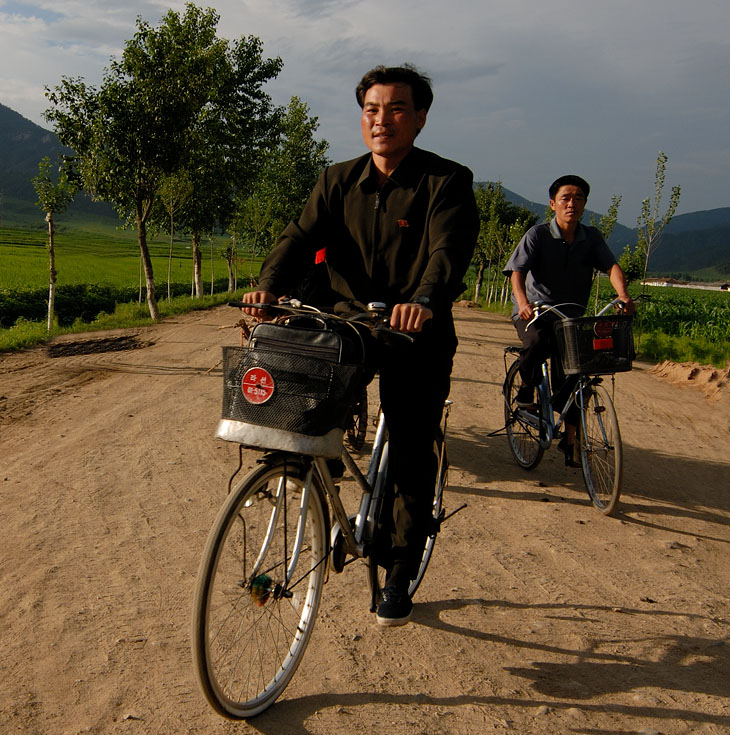
Put 1970s China in a time capsule, you get this magnificient Russia travelogue in North Korea today (full 7 pages of pictures).
Approximated translation with babelfish translator.
Rural Korea
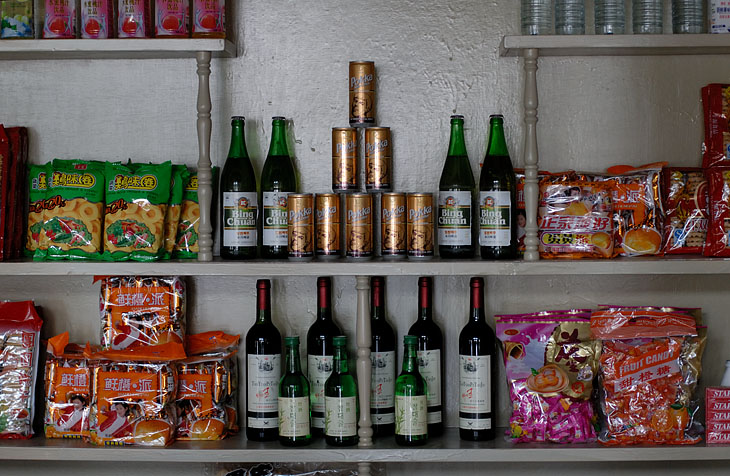
SOE store shelf
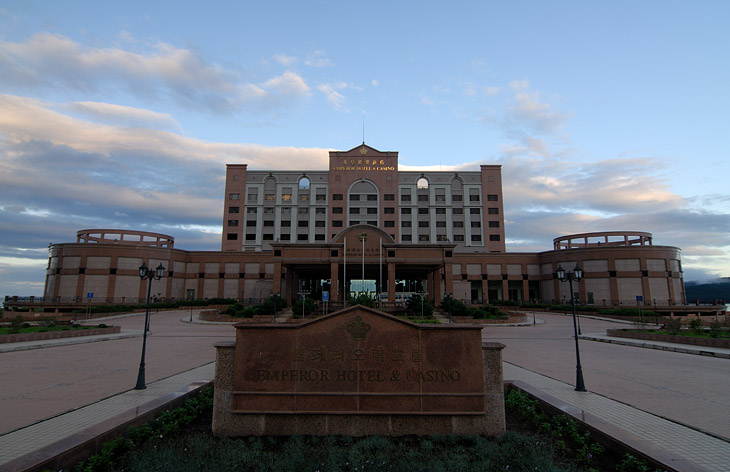
The infamous casino built by HK tycoon Yeung Shao-Shing near Siniujiu
Click the link to see the rest.
---
More
3) More Mass Game videos
Children section (note music from Small World and Chinese Songs in beginning)
Defense section
4) "Supreme Leader Kim Jong-il" March MTV
5) NK exporting labor to Russia now. These are tough low pay jobs, but better than at home.
6) Propaganda videos from Tadspot.
7) What about the DPRK that the government does not want you to see? here is a video of the NK street orphan, sad, but not unlike the underclass in other countries. Pay attention to the surrounding environment, that is real NK.
- "At the end of the story I would like to say some things. The northern Koreans by their mentality are uncomparably closer to Russians, than Europeans (I'm not even talking about Americans!). Even the Czechs are more far from us.
It's difficult to make examples (and they're not for public notes). But you must believe me: after a couple of days, when you stop pay attention to external and language differences, sometimes you get a strong feeling, that you talk to Russians.
The same moments as: "it's impossible, but if very much desirable, then it's possible". The understanding of some ambiguous moments without the words. Very similar "everyday problems" (of course, I compare not with the "new Russians"). The same principles of high education."
2) (via The Marmot's Hole)
Put 1970s China in a time capsule, you get this magnificient Russia travelogue in North Korea today (full 7 pages of pictures).
Approximated translation with babelfish translator.
Rural Korea
SOE store shelf
The infamous casino built by HK tycoon Yeung Shao-Shing near Siniujiu
Click the link to see the rest.
---
More
3) More Mass Game videos
Children section (note music from Small World and Chinese Songs in beginning)
Defense section
4) "Supreme Leader Kim Jong-il" March MTV
5) NK exporting labor to Russia now. These are tough low pay jobs, but better than at home.
6) Propaganda videos from Tadspot.
7) What about the DPRK that the government does not want you to see? here is a video of the NK street orphan, sad, but not unlike the underclass in other countries. Pay attention to the surrounding environment, that is real NK.
Sunday, July 30, 2006
Update: Taepodong-2's range, I was right and Vick was right.
I was right that TPD-2 did not go very far away from the launch site. GS's Vick agreed with more in depth analysis. An anonymous commentator confirmed by providing a set of typical rocket trajectory figures.
Now the main stream media followed, after pentagon confirmed with our analysis.
The question is, why did the information released by US (and indirectly, Japan) came more than 3 weeks late? I do have a hypothesis: it has to do with certain political agenda. 1) The matter needs to be misled before the UN resolution. 2) See another previous post for more hints. The outright lie and exaggeration (by more than 400 times) needed to stay for a while to save face and generate the impacts. It is very likely that someone (/country) probably delayed the release of the truth on purpose.
Now the main stream media followed, after pentagon confirmed with our analysis.
- The United States has told Japan that a long-range missile test-fired by North Korea this month exploded in mid-air just 1.5 kilometres from its launch site, much closer than previously estimated, news reports said today.
- Reuter: Sources quoted by Kyodo news agency said the missile exploded in mid-air within 1.5 km of the launch site, either in a northeastern region of North Korea or in its territorial waters on the edge of the Sea of Japan
- Japan Times: The United States has told Japan that the Taepodong-2 missile fired July 5 by North Korea exploded in midair within 1.5 km of the launchpad, not 400 to 600 km away as the Japanese government had initially estimated
- Yomiuri: The Japanese government initially reported that the missile fell into the Sea of Japan about 640 kilometers from the launch site. But the government will revise the report after officially announcing the analysis results in early August
The question is, why did the information released by US (and indirectly, Japan) came more than 3 weeks late? I do have a hypothesis: it has to do with certain political agenda. 1) The matter needs to be misled before the UN resolution. 2) See another previous post for more hints. The outright lie and exaggeration (by more than 400 times) needed to stay for a while to save face and generate the impacts. It is very likely that someone (/country) probably delayed the release of the truth on purpose.
Sunday, July 16, 2006
Joke of the day: paradise

A North Korean refugee has settled in Europe.
He visits a Museum with a few friends and see this picture.
The English said, "They are English. Look at the guy, how gentlemanly he is! He lets the lady eat the apple first."
The French said, "They are French. We are romantic people, we are proud to be nude and we are not afraid to eat forbidden apples."
The North Korean said, "You are all wrong. They are my compatriots. I am speaking on my own experiences. We have nothing to wear, nothing to eat, if we take an apple from the tree we will be punished. But we are all convinced that we live in paradise!"
Friday, July 14, 2006
Guo Jia (iii) - Three-way statecraft around the Sea of Japan (aks East Sea)
Guo Jia's theory basically tells us if there is some fissure within two parties, applying external pressure will bind them together tighter. OTOH, leaving them alone the fissure will surface sooner or later.
David@jujuflop commented (in Guo Jia (ii))when this theory was applied to the Taiwan political situation today, that the parties at odd could also be PFP and KMT. Yes and no. There is certainly fissure between these 2 parties and the relationship is related to external pressure, as already reflected in the elections of 2000 and 2004. In 2000 there was no external pressure and they were defeated by DPP despite gathering almost 60% of the popular votes. In 2004 external pressure bound them together and they ran up very close to DPP.
However, Guo Jia's point is about strategic choice, that one has a genuine choice of doing something, usually counter-intuitive, to change the alliance status of others. The results can only be credibly attributed to the influence of such strategic choice if the fissure is a hidden one, because once the fissure has already surfaced it is just a matter of time rather than the result of your action/inaction. The Taiwan Civil Society letter quote in "Guo Jia (ii)" is to some extent triggered by Bian's irresponsible (and lame) self-defense in front of the TV (and more so by DPP's complacency toward corruption), which was in turn forced by pan-Blue's recall motion. In addition, the fissure had been well underground. So I do not see the analogy could be applied to PFP/KMT spat, which is already quite open, yet.
---
Meanwhile, 3000 kilometers to the northeast of the beautiful island, Guo Jia (iii) is being played out.
David@jujuflop commented (in Guo Jia (ii))when this theory was applied to the Taiwan political situation today, that the parties at odd could also be PFP and KMT. Yes and no. There is certainly fissure between these 2 parties and the relationship is related to external pressure, as already reflected in the elections of 2000 and 2004. In 2000 there was no external pressure and they were defeated by DPP despite gathering almost 60% of the popular votes. In 2004 external pressure bound them together and they ran up very close to DPP.
However, Guo Jia's point is about strategic choice, that one has a genuine choice of doing something, usually counter-intuitive, to change the alliance status of others. The results can only be credibly attributed to the influence of such strategic choice if the fissure is a hidden one, because once the fissure has already surfaced it is just a matter of time rather than the result of your action/inaction. The Taiwan Civil Society letter quote in "Guo Jia (ii)" is to some extent triggered by Bian's irresponsible (and lame) self-defense in front of the TV (and more so by DPP's complacency toward corruption), which was in turn forced by pan-Blue's recall motion. In addition, the fissure had been well underground. So I do not see the analogy could be applied to PFP/KMT spat, which is already quite open, yet.
---
Meanwhile, 3000 kilometers to the northeast of the beautiful island, Guo Jia (iii) is being played out.
- North and South Korea are at odd. S Korea were furious at NK's missile testing. But Japan's overhyping had left S Korea with no choice but prioritized its perceived threats. If Japan genuinely wants peace around the Sea of Japan, the best approach is, as many have pointed out, to totally ignore the attention-seeking baby Kim Jong-il. If it really feels threatened, develop TMD quietly with the US
- However, this may not be Japan's objective (for once, People's Daily is right!). Japanese strategists are the also experts in Sun Zi and ROTK (esp Cao Cao). They are well aware of these case studies. Their true objective is more likely, as I noted before, "Pyongyang and Tokyo find themselves unlikely partners in fueling this vicious circle, each to fulfill its own military ambition."
- In fact, one can also apply Guo Jia's theory to the 3-way satecraft between China, DPRK and Japan. China has been extremely annoyed by DPRK's openly ignoring its advice, and is probably planning on punitive measure of its own. Now Japan's continued belligerence may well push China back to its complacency with NK. This is not what the US would like to see. American diplomats need to judge the situation and make their decision very carefully, for their own interests.
Wednesday, July 12, 2006
China's (North) Korea Dilemma, and the unlikely partners across the (East) Sea (/of Japan)
The Brits (Economist, BBC, and even the Times and the Guardian) probably still excels over their wealthy American counterparts in reporting, perhaps the talent pool of Oxbridge graduates does make a difference, more likely it that their reporters take a more objective view.
1) BBC on China's "tough decision"
-----
Facts:
Corollaries
China, Russia offer rival UN draft on N. Korea (Reuter),
朝鲜射导弹,中国成了替罪羊?(Washington Observer),
朝鲜半岛前景 (weizhou)
凤凰卫视揭密:志愿军为什么撤出朝鲜(Pheonix TV interview)
'Hyperpuissance,' a Myth in N. Korea - ASIAN SECURITY MONITOR
The China-North Korea Relationship (Adam Segal answers FAQ) - Esther Pan, Council of Foreign Relations
1) BBC on China's "tough decision"
- The fact that it is now threatening to [use its UN Security Council veto power] shows just how much Beijing believes its own vital national interest is at stake. (China never exercised its veto power)
- China's over-riding national interest is stability. The current situation on the Korean peninsula may not be a happy one, but from China's point of view, it is reasonably stable, and it could be a lot worse.
- The two things China fears the most are a North Korean collapse and another war on the Korean peninsula.
- There is a very basic problem with the six-party talks structure - North Korea does not like them. The six-party talks force Pyongyang to negotiate with five other countries, including South Korea and the much hated Japan. The North Korean leadership, however, is interested in negotiating with only one country, the US.
- China has repeatedly appealed to the US government to open direct talks with Pyongyang . .. But direct negotiations with Pyongyang are something the Bush administration has repeatedly refused to consider.
- 为了惩罚平壤,美国和日本企图通过联合 国安理会来对朝鲜实施经济制裁。但是中国和俄罗斯担心这一措施可能导致金正日进一步铤而走险,造成危机升级。因此中俄反对美日的建议。这样,朝鲜的导弹事 件又一次使中国战到了美日的对立面。中国对北朝鲜的影响力又是北京和华盛顿打交道时的一个重要的外交筹码。所以中国的最佳处境是一个相对顺从北京的北朝鲜 政权继续生存。
- ... The best situation for China is a relatively obeying North Korean regime which would continue to survive
- 但是目前金正日企图通过试射导弹和制造核武器来逼美国让步;同时平壤又不顾北京的公开告诫而进行导弹试验,这就迫使中国政府采取措施来迅速 控制局面,既不让美日制裁平壤的决议在联合国安理会通过(因为这可能加速金正日政权的垮台),又得使金正日尝到一点"苦头",从而不再做有害中国战略利益 的坏事。但为了对平壤施加压力,中国应该支持安理会谴责北朝鲜的决议并同时适度减少对北朝鲜的经济援助。只有这种相对平衡的反应才能使华盛顿感到北京是一 个真心诚意合作的伙伴。可是目前中国政府的反应让美国十分失望。北京既不支持联合国安理会通过的决议来谴责北朝鲜又没有采取任何教训金正日的措施。
- ... Pyongyang ignored the public appeal from Beijing and went on with its missile tests, thus forcing the Chinese governement to take measure to quickly control the situation. China needs to stop the sanction proposal by Japan and US in UNSC (because this would speed up the collapse of the Kim JI regime) [the subsequent refugee and instability would hurt China economically], and in the mean time show Kim Jong-il a bite of the bitter consequence, so that it won't do things harmful to China's strategic interests. However, to exert pressure on Pyongyang, China should support UNSC in condemning NK and reduce its economic aid to NK by an appropriate amount. Only such relatively balanced reaction would provide Washington with the impression of a sincerely cooperating partner. But what Chinese government has done now let US down. China did not support the UNSC proposal, and it did not take ANY measure to teach the Kim J-I regime
- 在某种 程度上来说,美日犯了一个严重的错误。在中日关系极度低迷的情况下,东京应保持低调,但令人困惑的是,日本在安理会采取了最强硬的立场并提出了制裁北朝鲜 的决议。东京积极努力的效果则[适得]其反。因为中国决不会让日本在处理朝鲜导弹事件上大出外交"风头"。因此东京越是强硬,北京就越会"反强硬",最终是安 理会中出现大国对立,形成外交僵局。如果北京不希望成为北朝鲜无赖行为的战略牺牲品,它现在应马上采取对金正日政权更强硬的措施。中国的国家利益不允许北 朝鲜吧北京拖入一场和华盛顿与东京的战略对抗
- To a certain extent, US and Japan made a serious mistake.... Tokyo should keep a low profile, but for reasons hard to understand, Japan took the most hard-line position in UN SC. Tokyo's effort achieved exactly the opposite of what it pushed for......it would result in the stand-off in UNSC, and diplomatic paralysis. If Beijing does not want to become the strategic sacrifice of North Korea's rouge behavior, it should take immediate stern measure now against the Kim Jong-il regime. The national interests of China does not allow North Korea to drag it into a strategic rivalry with Washington and Tokyo
-----
Facts:
- North Korea (and many other countries) has every right to test its missiles. The missile issue is technically unrelated to NK's nuke issue (six party talk). Although one could argue that a nuke is useless without a missile, IMO the nuke issue is a lot more serious because it could be used to make dirty bombs carried in suitcases
- As a matter of fact, many countries tested long range missiles all the time, including India just this week
- The technology for intercontinental ballistic missile (ICBM) is essentially a sub-set of the technology in launching a satellite . Because if you can send a satellite to space and retrieve it at a reasonably precise location, you could send a missile basically everywhere in the world, with similar precision. The only difference being, missiles should take thhe shortest path to minimize the probability of being intercepted.
- Japan already has the satellite capability, launched this February
- The Taepodong-2 is now understood as “almost certainly it was a satellite launch at an inclination of 41 degrees or perhaps a three stage booster dummy warhead launch to impact down range in the south Pacific relative to South America”
Corollaries
- China has demonstated genuine interests in dealing with the NK Problem. Otherwise, it would not have pushed for the one-one
datemeeting between Kim J-I and Bush W, which leaves itself out - If the Economist is correct, that NK's is making money on the missile tests. China has even better reason to reduce its aid, telling NK that it does not need so much aid since it is selling more Rodongs.
- China has no choice but to prevent a collapse of the NK regime, because the economic cost is just too large for China (and political implication for China's internal stability)
- In addition, there is no way China will agree to a binding sanction by UNSC, neither will russia or even S Korea. Because such sanction constrains these 3 countries but not others (who do not have contact with NK at all). In addition, it allows UN to inspect the goods at the Chinese border and provide excuse if there are minor mistake from low level Chinese staff. All 3 NK neighbors prefer a non-binding resolution and take the action by their own discretion. As a matter of fact, S Korea openly oppose sanction now.
- Had it been SK's turn to be represented in the UNSC rotation, China would not have to threaten with its veto power. Unfortunately it was Japan's turn at this moment. This event will strengthen China's (and SK's) objection to Japan's UNSC permanent membership.
- But this time, China has all the reasons (and excuses) to cut its aid to North Korea, as Pei correctly suggested. NK publicly ignored China's appeal, and there is sufficient international pressure on China to cut the aid, as least temporarily. Cuting the aid by 1/4 or even 1/2 would not neccessarily lead to the collapse of the NK regime, since they have enough fund to test the missile.
- In fact, one may argue it is stupid for China not to capitalize on this opportunity to show NK who the boss is, and bring Kim to submission once and for all -- by imposing sanction in its own way.
- If US has a genuine interest in dealing with the NK problem, it should try "one on one" negotiation with NK. The fact that US continue to refuse talking puzzles me. If US is really uncomfortable about this, it could ask China as an observer or have China host the negotiation, as a compromise. Bringing Japan in just side-track the negotiation into rather minor (and dated) issue of "1970 kidnapping". There is absolutely no role of Japan in the "six-apart" talk. The only value Japan could provide is perhaps economic aid in exchange of NK's giving up its nuke project, but South Korea alone can afford the cost.
- It is a reasonable suspicion that Japan has a secret intention to keep NK as a bogeyman, by insisting on marginal issues such as 'kidnapping', and now even provoking NK by the preemptive strike talk! (one could even suspect that Japan is sabotaging Chinese diplomatic envoy to NK, by providing NK with more chips on the table -- because the TMD should be more effective than a preemptive strike to shield Japan from missile attack). After all, Taepodongs do not know how to kidnap a Japanese citizen. OTOH, NK needs Japanese belligerence to justify its weapon development. It is a vicous circle, Pyongyang and Tokyo find themselves unlikely partners in fueling this vicious circle, each to fulfill its own military ambition.
China, Russia offer rival UN draft on N. Korea (Reuter),
朝鲜射导弹,中国成了替罪羊?(Washington Observer),
朝鲜半岛前景 (weizhou)
凤凰卫视揭密:志愿军为什么撤出朝鲜(Pheonix TV interview)
'Hyperpuissance,' a Myth in N. Korea - ASIAN SECURITY MONITOR
The China-North Korea Relationship (Adam Segal answers FAQ) - Esther Pan, Council of Foreign Relations
Monday, July 10, 2006
Yaks love the Qinghai Tibet Railway (ii) -- and geography
Part (i) here
The Railway under construction in 2005

First, the yaks love the new railway! (more yak on rail pictures here)

Weighing 1000kg a yak could derail a train. This offers a second explanation to why the rail needs to be guarded.
---
Geography


The highest point of the Railway is near Tanggula Pass. at 5072m (16,600ft) above sea level, i.e.,
Just south of the Tanggula Pass Station (5068m) is the highest point of the railway (5072m).
20km of the railway is above 5000m. 780 km from 4500 to 5000m.
The railways rises to above around 5000m, near the 1338m long Fenghuo Shan Tunnel and continue to be around that altitude beyond the pass. About 550km in length of this section is on permafrost, i.e. so high that the temperature is always signigicantly below freezing point.
Stations, tunnels and bridges on railway

Related links:
1) Wiki's station list, and stations with vista points.
2) Chinapage
3) Schaefer's "The Railway to Tibet"
4) BBC' new report on inauguration July 1st (video)
5) Timesonline: Passages for endangered chiru, and "Video monitoring shows that more than 800 antelope have already passed under the railway"

6) Comminganarchy has discussion on merit of train travel in the comment section
---
These pictures were taken in June between Andu and Tanggula Pass stations
Tibet Antelope (Chiru) (see also early post)

Tibetan donkey

The Railway under construction in 2005
First, the yaks love the new railway! (more yak on rail pictures here)
Weighing 1000kg a yak could derail a train. This offers a second explanation to why the rail needs to be guarded.
---
Geography
The highest point of the Railway is near Tanggula Pass. at 5072m (16,600ft) above sea level, i.e.,
- taller than Mont Blanc (4808m), Europe, the highest point in Europe is, technically Mt Elbrus (5642m) at Caucasus, Russia, about 10% higher than our Tangula Pass
- taller than Mt Massif (4897), highest of Antartica
- only 827m shorter than Mt Kilimanjaro (5895m), Africa
- Almost twice that of Mt Baitou/Changbai, between China and Korea (DPRK)
- 30% above Mt Fuji (3776m), 20% above Mt Jade (3952) of Taiwan Province, China (ROC), or Mt Kinabalu (4093m) at Sabah, Borner, Malaysia
- Higher than Mt Whitney (4421) at Sierra Nevada, or any point in the 48 US States, or the second highest point in Alaska Mt Sanford (16,237 ft) -- just 20% shorter than Mt McKinley (20,320 ft) in Denali, Alaska
Just south of the Tanggula Pass Station (5068m) is the highest point of the railway (5072m).
20km of the railway is above 5000m. 780 km from 4500 to 5000m.
The railways rises to above around 5000m, near the 1338m long Fenghuo Shan Tunnel and continue to be around that altitude beyond the pass. About 550km in length of this section is on permafrost, i.e. so high that the temperature is always signigicantly below freezing point.
Stations, tunnels and bridges on railway
Related links:
1) Wiki's station list, and stations with vista points.
2) Chinapage
3) Schaefer's "The Railway to Tibet"
4) BBC' new report on inauguration July 1st (video)
5) Timesonline: Passages for endangered chiru, and "Video monitoring shows that more than 800 antelope have already passed under the railway"
6) Comminganarchy has discussion on merit of train travel in the comment section
---
These pictures were taken in June between Andu and Tanggula Pass stations
Tibet Antelope (Chiru) (see also early post)
Tibetan donkey
Friday, July 7, 2006
Pearl Harbor II? Don't belive it
This is actually a geography post (Background (i) (ii) (iii)).
Apparently someone in Japan got very imaginative (or had some weed, got over-excited, or deliberate rumour mongering to capitalize on this incident - pick you choice), NK Zone wondered if it is supposed to be Pearl Harbor II, I guess half-jokingly.
Now why I think Sankei's claim is bullshit. Here comes the geography.
p.s. there are a lot of obvious errors in these new reports. e.g. the KHON link (perhaps it was a direct translation from Sankei) above had the missile range and the distance to Hawaii totally wrong. It then made a further mistake of saying the path to Hawaii does not pass a land area - Japan is in between N Korea and Hawaii!
Relates: With Few N. Korea Facts, a Rumor Got Launched
A warhead found in Alaska? The report's longevity illustrates the uncertainty and fear. -- LA Times
Update:
1) globalsecurity senior fellow CP Vick has a comprehensive analysis, the satellite launch theory seems to be the most likely -- consistent with my post here, that it either aims at the open sea or is a satellite launch. In any case, Hawaii was not the target, not was any US base from Alaska to California. If it were a satellite, then it could pass through the ocean near Hawaii, in theory.
Apparently someone in Japan got very imaginative (or had some weed, got over-excited, or deliberate rumour mongering to capitalize on this incident - pick you choice), NK Zone wondered if it is supposed to be Pearl Harbor II, I guess half-jokingly.
- "A North Korean missile launched on Wednesday was aimed at an area of the ocean close to Hawaii, a Japanese newspaper reported on Friday"
Now why I think Sankei's claim is bullshit. Here comes the geography.
- Although the theoretical estimate for the range of Taepodong-2 is large, 4000-10000km. The particular missile fired this week was believed to have a maximum range of 6000km (see, eg, Reuter report above), i.e. at best reaching somewhere in Alaska northwest of Anchorage, had the launch been successful. The estimate is based on the payload (assumed very small) and the amount of fuel and the type of fuel used in the rocket
- Now the great circle (shortest path) distance between Pyongyang and Anchorage is 6000km, and Pyongyang-Honululu 7400km (the launch pad at Musudan-ri is located at the NE of Poyongyang so one could subtract about 200km in the 2 numbers above) -- always remember that the distance is longer if the destination is closer to the equator, since our maps exaggerate distance near the poles.
p.s. there are a lot of obvious errors in these new reports. e.g. the KHON link (perhaps it was a direct translation from Sankei) above had the missile range and the distance to Hawaii totally wrong. It then made a further mistake of saying the path to Hawaii does not pass a land area - Japan is in between N Korea and Hawaii!
Relates: With Few N. Korea Facts, a Rumor Got Launched
A warhead found in Alaska? The report's longevity illustrates the uncertainty and fear. -- LA Times
Update:
1) globalsecurity senior fellow CP Vick has a comprehensive analysis, the satellite launch theory seems to be the most likely -- consistent with my post here, that it either aims at the open sea or is a satellite launch. In any case, Hawaii was not the target, not was any US base from Alaska to California. If it were a satellite, then it could pass through the ocean near Hawaii, in theory.
- "Almost certainly it was a satellite launch at an inclination of 41 degrees or perhaps a three stage booster dummy warhead launch to impact down range in the south Pacific relative to South America"
Where did Taepodong-2 land? (ii)
BBC has this chart, showing the Long range missile (TPD-2) landed about 400 km east of Korean coast (launch site musidan-ri).

...and wiki has a similar one

According to wiki, Taepodong-2's full speed is around 8-9km/s, and that the missile landed about 40 seconds after it was launched.
Let's do some simple maths, on the maximum distance the missile travelled. Let's assume the missile reached top speed before it landed (more likely it didn't. it would have started burning the second stage if it did, plus acceleration stopped a few seconds before it reached water surface), and let's assume only the horizontal component of the velocity (the range would be smaller for parabolic trajectory, because the horizontal component is less than 8-9km/s), then the upper bound of the distance traveled is:
Update: Globalsecurity confirms my hypothesis here. It also showed that the S Korean claim of 499km is incorrect and "appears to be mixing the other missile flight data observations". In fact, Globalsecurity's estime is only 1.4km, confirming my suspection that a lot of the energy was given to the vertical thrust upward.
"TIME___ ALT___ RNGE ___VEL.
(SEC)___ (KM)____ (KM) ___(KM/SEC)
40.0 ____4.3 _____ 1.2 _____ 0.25
45.0 ____ 5.6 _____ 1.7 _____ 0.29"
4.4km above sea level is like the peak of the highest mountain in Europe/US.
1.4km is slightly less than a mile or some 5 football fields away, just barely into the ocean
0.26km/sec=260m/s = 936km/hr = 585mph, which is sub-sonic and slightly higher than the cruising speed of a 747 airliner
...and wiki has a similar one

According to wiki, Taepodong-2's full speed is around 8-9km/s, and that the missile landed about 40 seconds after it was launched.
Let's do some simple maths, on the maximum distance the missile travelled. Let's assume the missile reached top speed before it landed (more likely it didn't. it would have started burning the second stage if it did, plus acceleration stopped a few seconds before it reached water surface), and let's assume only the horizontal component of the velocity (the range would be smaller for parabolic trajectory, because the horizontal component is less than 8-9km/s), then the upper bound of the distance traveled is:
- average speed x 40 sec
- = (0+8.5)/2 x 40 = 170 km
Update: Globalsecurity confirms my hypothesis here. It also showed that the S Korean claim of 499km is incorrect and "appears to be mixing the other missile flight data observations". In fact, Globalsecurity's estime is only 1.4km, confirming my suspection that a lot of the energy was given to the vertical thrust upward.
- "[Vick] is reasonably certain it was not aimed at the United States at a much higher inclination as discussed below. It ultimately impacted near the launch site infrastructure just off shore perhaps about 1.4 kilometers from the pad with perhaps 4.4 km altitude gained before collapsing into the Sea of Japan"
"TIME___ ALT___ RNGE ___VEL.
(SEC)___ (KM)____ (KM) ___(KM/SEC)
40.0 ____4.3 _____ 1.2 _____ 0.25
45.0 ____ 5.6 _____ 1.7 _____ 0.29"
4.4km above sea level is like the peak of the highest mountain in Europe/US.
1.4km is slightly less than a mile or some 5 football fields away, just barely into the ocean
0.26km/sec=260m/s = 936km/hr = 585mph, which is sub-sonic and slightly higher than the cruising speed of a 747 airliner
Wednesday, July 5, 2006
Distracting Japan? and other theories
North Korea's missile game, timed on July 4th in US (in fact it was July 5th local time), was widely read as an open provocation on US. More people believe it was a coincidence, but you never know what has gone through the minds of these crazy people. Conventional wisdom sees this as a bizzarre way of attracting attention and negotiation strategy. But I do not buy it.
There are other theories:
1) South Korea's scientific survey ship has arrived at Dokdo around the same time, conducting its 'survey'. News has been submerged with the missile "crisis". This explains why 7 useless out-dated Scuds were fired endlessly, and that the real focus, Taepodong-2, was a total fisaco. Perhaps that was intentional.
This may be a successful collaboration of the Korea's about Dokdo. But definitely not a good move for NK in the long term. It provided Japan with the excuse it needed to re-arm, and it was a major slap on China's face, especially after China openly appealed for NK not to do that.
2) The most plausible theory is that these missiles are for "internal consumption", i.e. This can be read as a sign that Kim Jong-il's power is in jeopardy. In order to tighten his control, KJI needs foreign pressure so that within DPRK his team would stick together. The best way to attract foreign pressure is to provoke responses. (See Guo Jia's advice to Cao Cao)
3) (Update Jul 7) NK Zone listed a few theories, including the 'conventional wisdoms' discussed above. But there is a much simpler explanation. Maybe NK has already invested so much resources into it, and it really want to see its toys work? (the timing is controlled by the fact that the fuel for this TPD-2 cannot be stored and has to fired within a month after preparation). This explains why it has gone ahead no matter what, but did not fully explain the other 5-6 smaller missiles.
4) (Update Jul 11) The Economist has a very plausible explanation. It believes that the launch was used to prove to other countires, potential buyers of the missile (ie Iran), that the technology works
N Korea does have its right to test the outdated gadgets (Scud, Rodong). It also has the right to develop its own Taepodong. It should, however, at least warn the fishermen in the area. Anyway, the damage, to NK itself, far outweighs any benefit it could justify, even if you count the distraction on Japan. Expect China abstaining, or even supporting all the UNSC motions propopsed by the US.
p.s.
1) Financial advice: buy time for the financial market, as there is absolutely no reason to sell for such insignificant naughtiness.
2) Compare Japan's hysteria with more rational reaction from Russia and China
There are other theories:
1) South Korea's scientific survey ship has arrived at Dokdo around the same time, conducting its 'survey'. News has been submerged with the missile "crisis". This explains why 7 useless out-dated Scuds were fired endlessly, and that the real focus, Taepodong-2, was a total fisaco. Perhaps that was intentional.
This may be a successful collaboration of the Korea's about Dokdo. But definitely not a good move for NK in the long term. It provided Japan with the excuse it needed to re-arm, and it was a major slap on China's face, especially after China openly appealed for NK not to do that.
2) The most plausible theory is that these missiles are for "internal consumption", i.e. This can be read as a sign that Kim Jong-il's power is in jeopardy. In order to tighten his control, KJI needs foreign pressure so that within DPRK his team would stick together. The best way to attract foreign pressure is to provoke responses. (See Guo Jia's advice to Cao Cao)
3) (Update Jul 7) NK Zone listed a few theories, including the 'conventional wisdoms' discussed above. But there is a much simpler explanation. Maybe NK has already invested so much resources into it, and it really want to see its toys work? (the timing is controlled by the fact that the fuel for this TPD-2 cannot be stored and has to fired within a month after preparation). This explains why it has gone ahead no matter what, but did not fully explain the other 5-6 smaller missiles.
4) (Update Jul 11) The Economist has a very plausible explanation. It believes that the launch was used to prove to other countires, potential buyers of the missile (ie Iran), that the technology works
N Korea does have its right to test the outdated gadgets (Scud, Rodong). It also has the right to develop its own Taepodong. It should, however, at least warn the fishermen in the area. Anyway, the damage, to NK itself, far outweighs any benefit it could justify, even if you count the distraction on Japan. Expect China abstaining, or even supporting all the UNSC motions propopsed by the US.
p.s.
1) Financial advice: buy time for the financial market, as there is absolutely no reason to sell for such insignificant naughtiness.
2) Compare Japan's hysteria with more rational reaction from Russia and China
Tuesday, July 4, 2006
Where did the North Korea missiles land?
Follow-up posts ii, iii, iv


Kim Jong-il has a secret affection on the US. He loves Hollywood movies, he has insisted on bilateral negotiation with Americans alone, now he is goes one step furtehr in congratulating the 230th anniversary of the Great American Revolution with a series of fireworks.
It is still unclear how many were fired, though it was believed to be 5, 6, 7 (and counting). Reportedly many were short-range Scud and the medium range Taepodong-2 failed (updates)35 42 seconsds after being fired. "The US considered the Scud/Rodong nothing unusual", as it is widely available to most countries in the world. The most relevant one, Taepodong, was reported (by NHK of Japan) to be in the Sea of Japan, 600km West of Hokkaido.


However, it was said that there may be more than one such launch sites for the 3-5 missiles fired. A couple hundred km south is the nuke siteat Soho-ri, Sinpo, near Songjin (40.09505600E,128.34080800N).

Update:
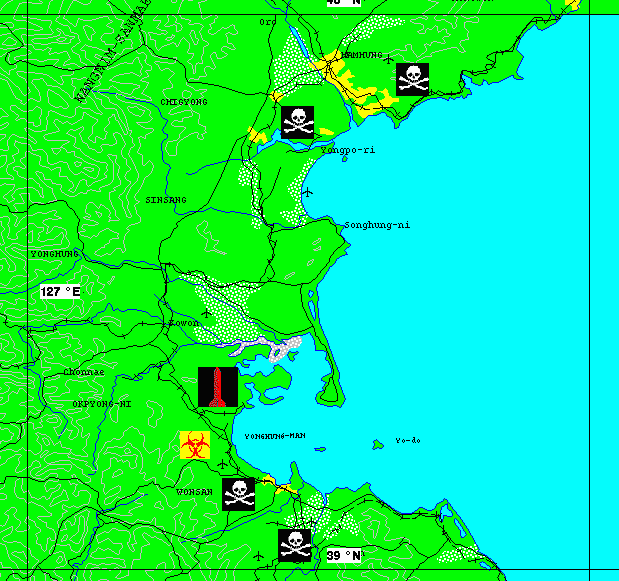
Kim Jong-il has a secret affection on the US. He loves Hollywood movies, he has insisted on bilateral negotiation with Americans alone, now he is goes one step furtehr in congratulating the 230th anniversary of the Great American Revolution with a series of fireworks.
-
(update - Bloomberg) 3:33 a.m. Scud-C, short-range ballistic missile, is launched. It lands in the Sea of Japan, short of Japanese coastline.
4:04 a.m. Rodong, medium-range ballistic missile, or a Scud-C is fired and lands short of Japan. This and first launch were not considered unusual by U.S. officials.
5:01 a.m. Taepodong-2, long-range ballistic missile, is launched and vanishes in less than a minute. This missile also landed in the Sea of Japan.
7:12 a.m. Scud-C, or other missile, fired and lands in Sea of Japan at 7:17 a.m.
7:31 a.m. Rodong missile is launched, landing in the Sea of Japan at 6:36 a.m. - (Update - AustraliaBC interview of Hugh White, ANU)
- KERRY O'BRIEN: Of course this is an enormously sensitive issue for the region, the whole question about Japan re-arming, so to speak, and that's a debate that's been gaining increasing currency in Japan anyway, hasn't it?
- PROFESSOR HUGH WHITE: ...The Chinese I think will be very angry with the North Koreans for, amongst other reasons, the fact that these launches will help to accelerate the development of Japan's own military capabilities and that of course will affect not just the balance of power between Japan and North Korea, but the balance of power between Japan and China. So it complicates a lot of strategic calculations in North-East Asia...... I think we can expect the Chinese to respond pretty strongly to this.
- KERRY O'BRIEN: That brings us to the final question: why on earth are they doing it? What's behind North Korea?
- PROFESSOR HUGH WHITE: It's a very hard question to answer, Kerry. There are two parts to it at least. The first is that I've no doubt that the North Koreans genuinely want to develop their capabilities and genuinely want to test missiles like the Taepodong-2 because they want to move towards the capacity to put a nuclear weapon on the United States, but I think there's also an element of diplomacy in this. In particular, they are in the middle of the six-party talks. The talks have been stalled for nearly a year now and the North Koreans are looking to get the US in particular to put more on the table, as an incentive for the North Koreans to walk away from their nuclear program and this is one way of upping the stakes and making the Americans more likely to put more on the table and give the North Koreans a better deal. It's a pretty high stakes way of conducting a negotiation, but that's the way that the North Koreans do it.
It is still unclear how many were fired, though it was believed to be 5, 6, 7 (and counting). Reportedly many were short-range Scud and the medium range Taepodong-2 failed (updates)
- 1) Sea of Japan does not mean it is part of Japan, just like Persian Gulf does not wholly belong to Iran, and Indian Ocean not wholly part of India. It could be misleading for those who are not familiar with geography.
- In fact, Japan's sovereign territory is only 12 nautical miles (22km) from its coast line. Its claimed EEZ can extend to 200 nautical miles (as long as it does not overlap the 200 n-mile zone or the continental shelf of another country) but this is disputed mainly because of the Dokto(Liancourt) dispute. (That Korean insisted that this be called "East Sea" seems to make sense now). So, in reality the Sea of Japan is international water, and the EEZ is shared by Korea, Russia and Japan.
- 2) Japan's claimed EEZ is shown as the yellow line in the map above. Note that Korea's claimed EEZ is to the East of this line because one would have to take Dokto/Liancourt and find the mid-line with Honshu.
- 3) The west end of the red line is 600km west of Hokkaido, where the missile reportedly fell. It is about 100km south of Vladivostok in international water, and probably falls in the EEZ of Russia.
- 4) All the 6 missiles (including the successfully launched Scud/Ronong) fell onto international waters
However, it was said that there may be more than one such launch sites for the 3-5 missiles fired. A couple hundred km south is the nuke siteat Soho-ri, Sinpo, near Songjin (40.09505600E,128.34080800N).
Update:
According to a South Korean spokeman, the missiles were launched from separate sites:
"This morning at 5 o’clock in Taepodong(大浦洞), Hwadae-gun (花台郡), in North Hamgyeong Province (咸镜北道) and from 3:32 a.m. in Gitdaeryung(旗杆岭), Anbyun, Gangwon Province, six missiles were launched including five Scud and Rodong and one Taepodong-2 missile," Cheong Wa Dae security secretary Suh Choo-suk said earlier reading a government statement after an emergency meeting of the National Security Council.Taepodong is the musudan-ri site above. Anbyon (安边) is SE of Wonsan (元山-江原道) in this map
Subscribe to:
Posts (Atom)