I wrote in 2005:
total GDP of China (in PPP) could be comparable to that of US in 15-20 years, in an optimistic scenario.
Now the Economist projected it to be around 2019, one year ahead of my optimistic scenario. I still think the Economist is a bit to optimistic.
Showing posts with label china. Show all posts
Tuesday, December 28, 2010
Saturday, November 27, 2010
Wednesday, November 10, 2010
Sunday, November 7, 2010
What was Zhan Qixiong plan when he was intercepted by Yonakuni?
This is the video taken by Yonakuni on the collision when it tried to intecept Minjinyu 5179.
First, let's note a few facts (see previous post for background and screenshots)
What would you do if you wre captain Zhan at this moment?
Yonakuni knew that and saw that. It braked/backpedaled and stayed at Y2 instead. You tried to avoid it but you still got to its tail.
Should you have taken 1 O'clock or 2 O'clock instead to be safe (even if H is at 3 O'clcok coming to you)? You probably should, and you probably had done all those earlier that morning. This is one of the many interceptions since early morning and the ordeal would take at least another 2-6 hours that day. Maybe they have videos for you trying hard to avoid collision as well. They are not going to show the public if all the other videos. If not for that over-zealous and over-confident sengoku38 san, no one in the public will be able to even see this video.
Maybe you should have made your own recording. But you cannot afford such gadgets, and were not prepared to bring a video-camera to this trip, After all, you are a poor fisherman trying to make some bugs. You are not coming here for eco-tour.
First, let's note a few facts (see previous post for background and screenshots)
- Yonakuni has taken a long circle to come in front of Minjinyu, starting from about 8 O'clock direction (of Minjinyu 5179) to reach 2 O'clock in the begining of the video, and was at around 11:30 O'clock when its end collided with Minjinyu 5179
- At around 8'30", you can see another JCG ship, probably Hateruma (Let call it H), behind Yonakuni and to the right of Minjinyu 5179. Since we did not see it before earlier while Yonakuni was circling in front of Minjinyu 5179, we can conclude that H was probably either at 7-8 O'clock direction for Minjinyu 5179, or some distance from the 3 O'clock direction
- The track thickened a lot right behind Yonakuni at the moment of the collision, most likely indicating it has slowed down and parked (confirmed by the relative motion of Yonakuni with the sea wave track in the video)
- You can see an island right behind Minjinyu 5179 (wiki said it is Huangwei Yu, also called Kubashima by Japan), indicating that Minjinyu was trying to sail away from the island and halted when being cut in front by Yonakuni
What would you do if you wre captain Zhan at this moment?
- Your boat is much slower than Yonakuni (10 knots vs 30-40 knots), so it is useless to go anywhere in front of it. 12-9 O'clock directions are ruled out. It takes some time for Yonakuni to make a u-turn so your best chance is go behind it.
- You cannot go backward. You probably arrived at this position and were planning to move forward. But you had to stop your engine because Yonakuni is cutting in front of you. Going backward will bring you closer to Huangwei Yu and bring you more trouble. You want to be as far away from Huangwei Yu as you can now.
- You should also see JCG H coming from behind and trying to round you up on the other side, so you should try to get as far away from Huangwei Yu as possible. You hope if you can get out of the 24 nm radius you would be free and avoid being caught and result in financial losses
- You options are anywhere from 3-12 O'Oclock. 12 O'clock (proceeding directly ahead) offer you the best chance to escape, because JCG H is behind you and may intercept you from behind on your right hand side Another reason to avoid your right hand side is that H probably is already at your 3 O'clock now.
- You see Yonakuni is moving, there are some 100-200m between you and Yonakuni, so by the time you reached its current position (Y0), it should have moved to Y1 already.
Yonakuni knew that and saw that. It braked/backpedaled and stayed at Y2 instead. You tried to avoid it but you still got to its tail.
Should you have taken 1 O'clock or 2 O'clock instead to be safe (even if H is at 3 O'clcok coming to you)? You probably should, and you probably had done all those earlier that morning. This is one of the many interceptions since early morning and the ordeal would take at least another 2-6 hours that day. Maybe they have videos for you trying hard to avoid collision as well. They are not going to show the public if all the other videos. If not for that over-zealous and over-confident sengoku38 san, no one in the public will be able to even see this video.
Maybe you should have made your own recording. But you cannot afford such gadgets, and were not prepared to bring a video-camera to this trip, After all, you are a poor fisherman trying to make some bugs. You are not coming here for eco-tour.
Which ship has made a change in direction before the collision of Mizuki and Minjinyu 5179 (UPDATED)
Update (Nov 17): upon a few more viewing, I have come to the conclusion that Minjinyu also made a turn of about 20-30 degree and at some point was not exactly facing left. I have updated my graph accordingly. Note also that I am not trying to prove that Minjinyu bears no responsibility at the collision. I believe both sides need to share the responsibility, since Mizuki also made a significant turn of some 240-270 degrees, and made its direction very unpredictable -- might have caused the seemingly erratic turn of Minjinyu. (But we really do not have solid evidence to say either way)
But before you go on I want you to first judge this picture, that if the boat has turned
Then you can find out the answer in this picture below (where the picture above is cropped from), taken from the end credit of the movie Suspect X (a great movie btw). I do not claim the situations are the same, but this just shows us how a partial picture is far from being a conclusive evidence. That is why I hope Japan would release all the 10 hours of videos it has taken.
===
In my previous post an anomymous commentator suggested that Minjinyu 5179 made a change of direction and hence ram into Mizuki. What he saw was the video taken from on board Mizuki, all it shows is the relative velocity. Fortunately, we are able to see another video taken by Hateruma during the exact same moment from a different angle. Here it is.
This is a screenshot taken by Japanprobe, from the video taken by Hateruma, observing the collision between Mizuki and 5178. You can see the trace behind Mizuki, when it just completed a 300 degree turn right in front of 5179. It is quite clear that it is Mizuki which had made a large angle turn just before the collision, towards the area blocking the path of 5179
A path with time scale based on the video, and the speed indicated by the intervals between the 10 second gaps is shown approximately here. Looking at the time scale you can also see that Mizuki has more or less parked (stationary speed) for the 30 seconds before the collision, while Minjinyu had actually slowed down a bit. You can view the video again to verify my chart.
1A) Mizuki speeding towards 5179 (0:47)
1B) Mizuki turned 90 degrees (1:10). Note that Minjinyu 5179 has already made its turn of 20-30 degree by then. So Minjinyu's turn was made most likely while Mizuki formed a T in front of it. Perhaps it was expecting Mizuki to continue sailing towards its right, so that turning left would avoid the much faster Mizuki.
1C) Mizuki completed the turn (1:08)
Since Mizuki is almost stationary while making the turn, we can estimate the speed of Minjinyu during the moments to be around its own length during 10 seconds. which is approximately 40m/10s or 4m/s=15km/hr.
If you compare the location of Mizuki between 0:26 and 0:29, in less than 3 seconds it traveled the length of its own of 46 meters (type びざん型巡視船 (2代))(marked by the white wave). So its speed is about 50m/3s = 60km/hr, 4 times the speed of fishing boat 5170. So even adjusting for it slower speed right after the turn, it must be able to avoid the crash it wanted to.
If this is still not conclusive, in the Mizuki video we can see two other JCG staff were taking videos, they should release those videos as well as additional data points.
---
Now back to the video taken from Mizuki.
A second JCG ship can be seen on the right of 5170, trying to encircle it from left behind
In 15 seconds, the 2nd JCG ship has moved to the left side of 5179, leaving a long white trace behind it, this shows the significant difference in relative speed of JCG boats and Minjinyu 5179
The encircling tactic is not uncommon from JCG. This is an aerial photo from another act by JCG, probably taken in 1998 in the same area. This may be the plan of the JCG ships.
See also a different view in this NBR thread, there are some problem with the poster's observation though, e.g. he claimed there were 2 JCG ships, in fact there were at least 3, the Yonakuni, the Mizuki, and the Kateruma.
Friday, November 5, 2010
The Diaoyu Collision Videos
Update 3:
More analysis of the collisions
1) Which ship has made a change in direction before the collision of Mizuki and Minjinyu 5179
2) What was Zhan Qixiong plan when he was intercepted by Yonakuni?
Update 2:
Some discussion in the comment. I would recap here.
How the collision happened, and the routing of the JCG ships and the Chinese boat are pretty clear after viewing these videos.
This is actually quite similar to the case of the Hainan flight collision between a Chinese fighter and American spy plane in April 2001.
Now the issues (and comparison) really are:
1) From Japan's perspective, the JCG is 'enforcing' its law in its water. The question is comparable to whether a police boat should block the course of a civilian when it disobeyed order. And whether the enforcement should be as aggressive in certain disputed area with a foreign boat.
2) From Chinese perspective, Japan simply has no right to enforce its law in this area.
3) From a third party's view. The issues are
a) shall enforcement be this aggressive, assuming even if this area belong to Japan (as many Japanese would say, the Russian were much more aggressive, and opened fire in South Kuriles)?
b) shall the fishing boat change course (or is it possible for it to do so technically, given it is much slowed to control the speed and direction of a boat than a car)?
c) has the captain been avoiding such collision for the whole 4-5 hours of hide and chase game, and eventually lose either concentration or patience and gave up on steering control?
d) the area seems to be within 12 nm of the island (as you can see the islands in the background in Yonakuni video). so this is not the high sea. but again, it is disputed area and enforcement should be more scrupulous.
Related links
1) ESWN: Hong Kong Media Reaction To Diaoyuatai Collision Video
2) 日艦故意讓「閩晉漁」撞上 操弄錄影片段枉費心機
3) 釣島撞船片外洩 中日矛盾惡化
4) 故意不播周旋過程
5) 專家:日艦違慣例強攔漁船
---
Update 1:
1) 282 DVDs discovered in JR Station, with leaflet of "This shows the truth about DPJ. Please help yourself for free"
2) Asahi's speculation of the rationale for the leak.
---
The two collision videos are finally viewable -- just as I suspected before, Kan government clearly has every reason to keep the videos to themselves, But LDP will not let go of this opportunity to discredit its political rival. I suspect the leak is from DPJ's political enemies. (The leak's youtube ID is Sengoku38. While Sankei tried to explain the connotation of 38 as gossip women in Chinese. 38 are also good fortune number is South China. So it might as well be Chinese hacker who leaked the video)
1) This is taken by crew on Yonakuni. You can see Yonakuni started from the right flank of Minjinyu 5179, cut in front of it (and obviously doing this very slowly or even 'parked' in order to intercept the fishing boat). Minjinyu's direction did not change much throughout the video and its velocity was not fast and didn't change much. When the boats collide you can see the white wave track left behind by Yonakuni, showing that it had just crossed in front of Minjinyu. From the track you can see Yonakuni's speed was much faster than Minjinyu. It makes one wonders why it slowed down (instead of sped up) while parked in front of Minjinyu.
See the white track behind Minjinyu. Yonakuni had came from behind Minjinyu and circled it from its left aft, right aft, right flank, then cross in front of it. See all that Minjinyu left no visible track, showing that its speed was much much slower than Yonakuni. The fact that Minjinyu did not crossed the white track behind also indicated that the amount of time Yonakuni has to circle Minjinyu was less than the amount of time Minjinyu has taken to go across the circle (for a perfect circle, the speed ratio will be at least pi/2=1.57 times)
1A) White track behind Minjinyu
1B)White track to the right of Minjinyu
1C) Right before collision, white track behind Yonakuni. Yonakuni has just made an almost 90 degree turn in front of Minjinyu.
1D) After collision, no more white track as Minjinyu broke out of the "white circle".
Compare this with earlier CGI released by Japan you will understand why CGI is preferred over the real thing for Japan.
2) This one was taken by another JCG ship, Hateruma. In the first second of the video, it shows that Mizuki has just sped past Minjinyu and turned around in front of Minjinyu (see the semi-circle white wave track). Mizuki then sailed toward the Chinese fishing boat, then did a quick turn around right in front of Minjinyu, slowed down and parked and got hit by the Chinese boat which apparently could not brake nor turn (or reluctant/slow to turn).(for English subtitle version see here)
2A) Mizuki Turn around in front of Minjinyu to intercept
2B) Mizuki speed toward Minjinyu after first turn
2C) Mizuki, reach in front of Minjinyu, turned again to block Minjinyu from its front, the next video starts here, filming the left side of Minjinyu. You can see that Minjinyu did not change direction, while Mizuki turned into its way. It is not clear whether Minjinyu would have enough time to change course, or if it did, Mizuki would not move again to block it.
This is taken on Mizuki. It very clearly shows the JCG ship Mizuki sped up to intercept the Chinese Fishing Boat. In the beginning of the video, the two boats almost sailed side by side. Note also that a lot of black smoke came out from Mizuki a few seconds BEFORE the collision, similar to what you see when one pushes the pedal suddenly on a truck uphill.
This is taken a second before the collision, Note the thick black smoke from Mizuki.
The JCG boats seem determined to intercept the Chinese fishing boat. The Chinese fishing boat (Minjinyu 5179) seems determined to get out of the encirclement. The JCG boats are 3 times in length (translates into 27 times in size/volume/tonnage - Yonakuni is 89 meter long, 1300 ton displacement, vs Minjinyu 5179's 30 meter length and about 40 tons in displacement) and much faster than the fishing boat. As I had earlier speculated, it is extremely unlikely that any sane skipper will want to run into ships 27 times its size with much stronger steel body, nor that a much slower fishing boat would be fast enough to chase up the JCG ship. This looks like a replay of the 2008 Lien Ho Incident.
Relative size of A JCG ship and Minjinyu
In short, these videos do not help with JCG's case against skipper Zhan. It explain why Japan had to release the captain.
The Chinese MoFA spokesman Cui Tian Kai is now very adamant, "[Regarding what actually happened], The facts are very clear..."
More analysis of the collisions
1) Which ship has made a change in direction before the collision of Mizuki and Minjinyu 5179
2) What was Zhan Qixiong plan when he was intercepted by Yonakuni?
Update 2:
Some discussion in the comment. I would recap here.
How the collision happened, and the routing of the JCG ships and the Chinese boat are pretty clear after viewing these videos.
This is actually quite similar to the case of the Hainan flight collision between a Chinese fighter and American spy plane in April 2001.
Now the issues (and comparison) really are:
1) From Japan's perspective, the JCG is 'enforcing' its law in its water. The question is comparable to whether a police boat should block the course of a civilian when it disobeyed order. And whether the enforcement should be as aggressive in certain disputed area with a foreign boat.
2) From Chinese perspective, Japan simply has no right to enforce its law in this area.
3) From a third party's view. The issues are
a) shall enforcement be this aggressive, assuming even if this area belong to Japan (as many Japanese would say, the Russian were much more aggressive, and opened fire in South Kuriles)?
b) shall the fishing boat change course (or is it possible for it to do so technically, given it is much slowed to control the speed and direction of a boat than a car)?
c) has the captain been avoiding such collision for the whole 4-5 hours of hide and chase game, and eventually lose either concentration or patience and gave up on steering control?
d) the area seems to be within 12 nm of the island (as you can see the islands in the background in Yonakuni video). so this is not the high sea. but again, it is disputed area and enforcement should be more scrupulous.
Related links
1) ESWN: Hong Kong Media Reaction To Diaoyuatai Collision Video
2) 日艦故意讓「閩晉漁」撞上 操弄錄影片段枉費心機
3) 釣島撞船片外洩 中日矛盾惡化
4) 故意不播周旋過程
5) 專家:日艦違慣例強攔漁船
---
Update 1:
1) 282 DVDs discovered in JR Station, with leaflet of "This shows the truth about DPJ. Please help yourself for free"
2) Asahi's speculation of the rationale for the leak.
---
The two collision videos are finally viewable -- just as I suspected before, Kan government clearly has every reason to keep the videos to themselves, But LDP will not let go of this opportunity to discredit its political rival. I suspect the leak is from DPJ's political enemies. (The leak's youtube ID is Sengoku38. While Sankei tried to explain the connotation of 38 as gossip women in Chinese. 38 are also good fortune number is South China. So it might as well be Chinese hacker who leaked the video)
1) This is taken by crew on Yonakuni. You can see Yonakuni started from the right flank of Minjinyu 5179, cut in front of it (and obviously doing this very slowly or even 'parked' in order to intercept the fishing boat). Minjinyu's direction did not change much throughout the video and its velocity was not fast and didn't change much. When the boats collide you can see the white wave track left behind by Yonakuni, showing that it had just crossed in front of Minjinyu. From the track you can see Yonakuni's speed was much faster than Minjinyu. It makes one wonders why it slowed down (instead of sped up) while parked in front of Minjinyu.
See the white track behind Minjinyu. Yonakuni had came from behind Minjinyu and circled it from its left aft, right aft, right flank, then cross in front of it. See all that Minjinyu left no visible track, showing that its speed was much much slower than Yonakuni. The fact that Minjinyu did not crossed the white track behind also indicated that the amount of time Yonakuni has to circle Minjinyu was less than the amount of time Minjinyu has taken to go across the circle (for a perfect circle, the speed ratio will be at least pi/2=1.57 times)
1A) White track behind Minjinyu
1B)White track to the right of Minjinyu
1C) Right before collision, white track behind Yonakuni. Yonakuni has just made an almost 90 degree turn in front of Minjinyu.
1D) After collision, no more white track as Minjinyu broke out of the "white circle".
Compare this with earlier CGI released by Japan you will understand why CGI is preferred over the real thing for Japan.
2) This one was taken by another JCG ship, Hateruma. In the first second of the video, it shows that Mizuki has just sped past Minjinyu and turned around in front of Minjinyu (see the semi-circle white wave track). Mizuki then sailed toward the Chinese fishing boat, then did a quick turn around right in front of Minjinyu, slowed down and parked and got hit by the Chinese boat which apparently could not brake nor turn (or reluctant/slow to turn).(for English subtitle version see here)
2A) Mizuki Turn around in front of Minjinyu to intercept
2B) Mizuki speed toward Minjinyu after first turn
2C) Mizuki, reach in front of Minjinyu, turned again to block Minjinyu from its front, the next video starts here, filming the left side of Minjinyu. You can see that Minjinyu did not change direction, while Mizuki turned into its way. It is not clear whether Minjinyu would have enough time to change course, or if it did, Mizuki would not move again to block it.
This is taken on Mizuki. It very clearly shows the JCG ship Mizuki sped up to intercept the Chinese Fishing Boat. In the beginning of the video, the two boats almost sailed side by side. Note also that a lot of black smoke came out from Mizuki a few seconds BEFORE the collision, similar to what you see when one pushes the pedal suddenly on a truck uphill.
This is taken a second before the collision, Note the thick black smoke from Mizuki.
The JCG boats seem determined to intercept the Chinese fishing boat. The Chinese fishing boat (Minjinyu 5179) seems determined to get out of the encirclement. The JCG boats are 3 times in length (translates into 27 times in size/volume/tonnage - Yonakuni is 89 meter long, 1300 ton displacement, vs Minjinyu 5179's 30 meter length and about 40 tons in displacement) and much faster than the fishing boat. As I had earlier speculated, it is extremely unlikely that any sane skipper will want to run into ships 27 times its size with much stronger steel body, nor that a much slower fishing boat would be fast enough to chase up the JCG ship. This looks like a replay of the 2008 Lien Ho Incident.
Relative size of A JCG ship and Minjinyu
- Hateruma: 89m, 1300 ton (speed about 60km/hr or 30-40 knots)
- Yonakuni: 89m, 1300 ton (speed about 60km/hr or 30-40 knots)
- Mizuki: 46m, 197 ton (speed about 45-45 knots)
- Minjinyu5179: 30m, 40 ton (speed about 15km/hr or 10-15knots)
In short, these videos do not help with JCG's case against skipper Zhan. It explain why Japan had to release the captain.
The Chinese MoFA spokesman Cui Tian Kai is now very adamant, "[Regarding what actually happened], The facts are very clear..."
Saturday, October 23, 2010
So what did Ma Ying-Jeou say?
Background see e.g., "Despite his clarification and similar statements by other officials, some commentators insisted that the AP report showed Ma's intention to start political negotiations with Beijing if he wins re-election." - Focus Taiwan
The full excerpt is now published (or here). This is what Ma actually said,
Mr Hutzler, you need to do your homework before an interview, and you need to go back to school to study how to write a report.
The full excerpt is now published (or here). This is what Ma actually said,
- AP: So, do I understand you correctly that, if economic issues are
resolved during your second term, during that term, you might move on
to political questions?
[00:32:17]
President Ma: As I said, it depends on how fast we move, whether these
issues are satisfactorily resolved, and of course all the policies regarding
the mainland are very sensitive, and we certainly will also make decisions
on generally whether the decision receives popular support. So usually
when we lay out our general policy, we will say that: first of all, it has to
be something needed by the country; secondly, it has to be supported by
the people; and thirdly, that it will be supervised by the national
parliament to make sure that this is a policy basically meeting the needs
of the people.
- In between the poles of union and separation, Ma said his government is prepared to discuss political agreements, including security issues, as soon as the priority economic issues are dealt with. He suggested that those political talks could start as early as a second four-year term if he wins re-election in 2012.
- "We are not intentionally delaying the talks on political issues. Certainly the economic ones are more important to people here. People also support the idea (of) economy first, politics later," said Ma. Asked if he would move to political talks in a second term once economic issues are dealt with, Ma said "it depends on how fast we move." Political issues, he said, "will come after all the major economic issues are resolved."
- [45:20]
AP: Now, since you touched on the natural resources, the U.S. has voiced
some concerns that, you know, there’s the Diaoyutai and then there’s the
larger issue of the free passage of shipping through the South and East
China seas and access to natural gas deposits or whatever might be down
there on the ocean floor. And the U.S. has voiced concerns that the
mainland is really trying to cut off access to foreign trade in that area,
which would have, obviously, a poor effect on Taiwan, which really owes
its existence to free access to those shipping lanes. So, do you share the
concerns of the United States?
[45:53]
President Ma: Certainly. I think most of the waters in the South China
Sea should be open waters, the so-called high seas according to the Law
of the Sea. And they’re open to international traffic for sure. Actually, as I
said, countries started to occupy and garrison those islands a long time
ago. So this is not a very new issue. We sent our troops, our Marine Corps,
to station on those islands as early as 1956. Just 10 years ago, we changed
that with Coast Guard instead of the Marines. I served in our Navy more
than 30 years ago, and my unit had the responsibility to supply all these
islands. So I understand this issue well.
AP: So is China trying to interfere with the open water policy?
[46:52]
President Ma: No. So far no. And I don’t think mainland China would do
that. You know, when they are becoming a power in the region, they also
become more careful about those issues. Certainly, it wants to maintain
its sphere of influence but I don’t believe that will reach the level of
interfering with international traffic.
16
[47:15]
AP: They often raise objections to the passage of U.S. military ships
through the South China Sea and they have, at times, taken measures to
block those ships from passing through. The argument that some people
in the mainland make is that free passage does not extend to military
vessels, that that can be considered to be preparing the battlefield for the
future. Does your government believe that these types of military
surveillance activities are normal and should be allowed?
President Ma: Well, certainly all the activities on the oceans, particularly
in international waters, are regulated by the United Nations Convention
on the Law of the Sea of 1982, which came into effect in 1994. It’s very
important to note that there are rules of conduct. For instance, a warship
is not supposed to sail through the territorial waters of other countries, but
if the waters are too narrow in an international strait, then they certainly
have to do certain things to make sure that it’s an innocent passage. There
are rules. I think that each country should follow the rules.
- "China has lodged a solemn representation to the United States as the USNS Impeccable conducted activities in China's special economic zone in the South China Sea without China's permission," Chinese Foreign Ministry spokesman Ma Zhaoxu told a regular news briefing.
- "We demand that the United States put an immediate stop to related activities and take effective measures to prevent similar acts from happening," Ma said.
Mr Hutzler, you need to do your homework before an interview, and you need to go back to school to study how to write a report.
Friday, October 8, 2010
Friday, October 1, 2010
Clarifying Western Media Accounts of “China Rare Earth Metal Ban” - Lisa Reisman, Metalminer
(Update) One note: many local papers falsely claimed that "China mines all 17 types of rare earths", or even "China is the only country that mines all 17 types". This is WRONG. To start with, there are only 16 elements to be mined, the Promethium is radioactive and decays quickly (the most stable isotope of Promethium lose half of its atoms every 17.7 years). So, nobody, including China, mines Promethium.
Watch Lisa Reisman on the alleged RRE "ban".
In fact, even from the mother of all rumours, this NYT report, this was not really a ban,
- Industry officials said that mainland China’s customs agency had notified companies that they were not allowed to ship to Japan any rare earth oxides, rare earth salts or pure rare earth metals, although the shipments are still allowed to go to Hong Kong, Singapore and other destinations. But no ban has been imposed on the export to Japan of semi-processed alloys that combine rare earths with other materials, the officials said. China has been trying to expand its alloy industry to create higher-paying jobs in mining areas, instead of exporting raw materials for initial processing.
Having reviewed this, it makes one wonders, if not for the rare earths, what made Japan released the captain in such an abrupt change of stance? IMO, as I wrote in Chinese a couple days earlier, there are two plausible explanations. (1) that the local prosecutor did reached this decision on his own, based on the circumstantial evidence; (2) that what Kan perceived was the determination of the PRC government in even risking a lose-lose fight in this issue, as it directly challenged its legitimacy domestically.
Thursday, September 30, 2010
A truer picture of China’s export machine - McKinsey
A truer picture of China’s export machine
China’s growth depends less on exports than conventional wisdom suggests.
SEPTEMBER 2010 • John Horn, Vivien Singer, and Jonathan Woetzel
Source: Strategy Practice
In This Article
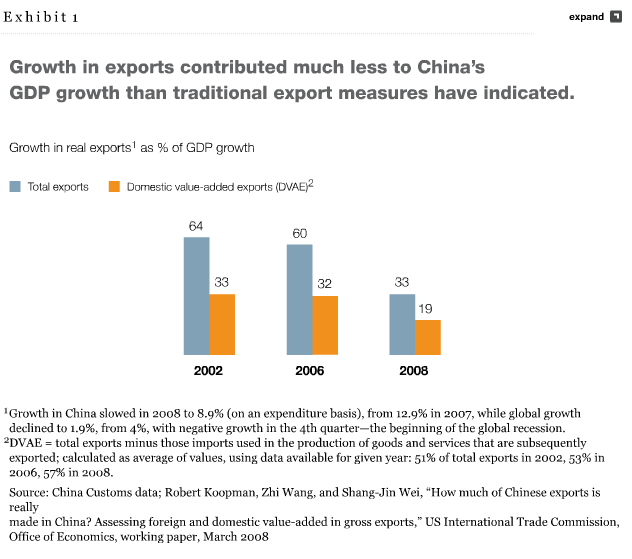
Exhibit 1: Growth in exports contributed much less to China’s GDP growth than traditional export measures have indicated.
Exhibit 2: The contribution of exports, measured as DVAE, to overall growth has fluctuated significantly in recent years.
Is China’s economic growth largely dependent on exports, or is it becoming more domestically led? That’s a question economists are vigorously debating—and an important one for policy makers and executives alike. An increasingly consumption- and investment-focused Chinese economy could improve the chances of more balanced trading relationships with developed economies. At the same time, businesses operating in China or planning to enter it could find greater opportunities as the economy accelerated its transition from a manufacturing center to a key consumer market.
To shed light on this question, we developed a new way of measuring the role of export growth in China’s overall economic expansion. We found that exports have been a major driver, but not one as dominant as commonly believed. Indeed, there are clear signs that a shift toward domestically driven economic growth is well under way. The picture that emerges of the Chinese economy has implications for the growth and supply chain strategies of businesses in China and elsewhere.
A different way to measure exports
Arguments over the true nature of China’s economic reliance on exports have been rooted in the difficulty of appropriately measuring the export sector. The traditional measure governments and most analysts use is the growth of total exports as a share of GDP growth. This measure indicates that export growth has accounted, on average, for almost 40 percent of the total growth in real GDP since 1990—rising to almost 60 percent since 2000.
Yet these numbers, portraying a dominant and growing role of exports, are at odds with the fact that China was one of the few countries that escaped the great 2008–09 global downturn without a major economic slowdown—suggesting that internal growth played an important role. That’s one reason other economists have used a very different measure: growth in net exports (total exports minus total imports) as a share of GDP growth. By that metric, exports contributed only between 10 and 20 percent of China’s annual 10 percent GDP growth in recent years.
We contend that both measures are misleading. Using total exports neglects the fact that many of China’s export shipments include a fair number of imported goods that are reassembled, combined with domestic content, or otherwise modified before being exported. Failing to remove these imports from the total export figure overstates how much value exports contribute to GDP. On the other hand, a strict net export measure (exports minus imports) underestimates the contribution of exports to GDP, because many imports aren’t used in assembly and exported but rather sold to Chinese consumers and businesses.
We calculated a measure we call domestic value-added exports (DVAE) to assess more accurately the role of exports in GDP growth. DVAE is what you get after subtracting from total exports only those imports used in the production of goods and services that are subsequently exported. In automobiles, for example, finished imports are not subtracted from our measure of exports. But engine parts imported to manufacture motor bikes for export would be.
Governments usually don’t break out total imports into those used domestically (for production, investment, and consumption) and those used for exports, and China is no exception. So we estimated the country’s DVAE by using data from three different sources, each with its own strengths and limitations. The results were remarkably consistent—and collectively shed a powerful light on the evolution of supply chain strategies, Chinese consumption, and Chinese economic performance during the global downturn .
Supply chain shifts
On average, our analysis suggests that imported goods accounted for 40 to 55 percent of the value of total exports from 2002 to 2008. Put another way, roughly half of China’s exports represent domestic value added. Concurrently, DVAE’s share of exports generally has risen over time, suggesting that China has become less of a pure assembler of imported goods—a publicly stated government policy goal.
That has implications for many companies’ supply chains and business models. If your company is a manufacturer in China that is primarily processing intermediate components for reexport—a Taiwan-based original-design manufacturer (ODM) of household goods, for example—it’s probably time to consider alternative locations for the assembly work. With China moving up the value chain and beginning to export more skill-intensive goods and services, chances are that pure assembly will soon be less costly in other parts of Asia.
Exports, consumption, and strategy
We also applied our DVAE analysis to reassess the contribution of exports to GDP growth in the years for which we have overlapping data among our three metrics. We found that China’s export sector contributed 19 to 33 percent of total GDP growth between 2002 and 2008 (Exhibit 1). That’s only about half of the export contribution indicated by traditional total-exports measures.3
In other words, DVAE analysis suggests that exports have been an important driver of China’s growth, but not the dominant one, and that most common wisdom overestimates the role of exports while underestimating the role of domestic consumption for China’s growth. Any Chinese or multinational company that currently manufactures goods in China and primarily exports them to other countries should ask itself whether it needs to scale up its domestic strategy to get a bigger piece of the pie. This involves developing a more granular understanding of the Chinese market, making products that appeal to the Chinese consumer, and finding ways to market and distribute them effectively—all while contending with increasingly formidable Chinese competitors.4
China’s ‘downturn’ and the road ahead
A comparison between DVAE’s contribution to growth and that of other major macroeconomic components shows that DVAE topped private consumption, but was less important than investment, over the 2002–07 period (Exhibit 2). In the downturn years, 2008 and 2009,5 exports contributed much less to growth than other factors did, which explains why the Chinese economy could not fully match its GDP growth rates in the earlier part of the decade. However, the shift to a greater role for private consumption, investment, and finished imports explains how China could weather the downturn well and indicates movement toward a domestically focused economy, even though exports will probably continue to play an important role when the global economy picks up.
Of course, continued changes in the value of the renminbi in the coming years will also affect the evolution of Chinese trade. The more value-added-focused export sector suggested by our DVAE analysis implies that a greater share of exports will consist of higher-priced goods that compete more directly with those of developed nations. That, coupled with an appreciating Chinese currency, points to the creation of more balanced trading partnerships with the rest of the world—and an important shift in context when businesses consider future strategic moves in China.
About the Authors
John Horn is a consultant in McKinsey’s Washington, DC, office; Vivien Singer is a consultant with the McKinsey Global Institute; and Jonathan Woetzel is a director in the Shanghai office.
Notes
1 In this article, we address only national GDP, not employment or regional effects within China. Our interest is the overall health of the Chinese economy, and we leave aside the question of which groups or regions are better off because of any changes in the overall level of exports.
2 Calculated from the McKinsey Global Institute (MGI) China urbanization model.
3 Not surprising, exports measured by domestic value-added exports (DVAE) contributed more—almost two times more—to GDP growth than exports measured on a net basis. DVAE therefore represents a middle ground between total- and net-export measures.
4 See Jeff Galvin, Jimmy Hexter, and Martin Hirt, “Building a second home in China,” mckinseyquarterly.com, June 2010; and Yuval Atsmon et al., “2009 Annual Chinese Consumer Study, Part II: One Country, Many Markets—Targeting the Chinese Consumer with McKinsey ClusterMap,” McKinsey Insights China, September 2009.
5 The DVAE for 2009 is based on data from IHS Global Insight only.
Wednesday, September 22, 2010
The 1783/1785 Ryukyu Map by Japanese cartographer Hayashi
Nicolas Kristof's blog regarding Diaoyu (Pinnacles Islands aka Senkaku as translated by Japanese) has attracted a letter from the Japanese government. He maintained his view, but also published the letter from Japan to provide the other side of the argument.
This (三国通覧図説 / 林子平 図並説)should be the 1783 map mentioned in Kristof's blog. It was mentioned by (Japanese version and the source of the map below)Japanese scholar by Kiyoshi Inoue , Professor of History department, Kyoto University
Diaoyu and Taiwan portion enlarged (Diaoyu colored same as Qing's, instead of classified as "uninhabited" like Ogasawara. As Professor Inoue indicated, the map is probably created based on his reading of the Chinese travelogue)
Japan was first interested in Ryukyu in 1885 but waited till January of 1895 to formally set claim on the islands, by then the Japanese army had already completely smashed Qing' navy and army, and have taken Lushunkou near today's Dalian in November 1894. The Shimonoseki Treaty was signed in April but the war was almost finished by January. Some used the difference in dates (January vs April) to claim that the Diaoyu was not part of the spoil of the war, but the fact is the Pescadores Islands (Penghu) was taken by the Japanese in March 1895, also before the signing of the Treaty.
However, I am not as confident as Kristof about how ICJ would decide, for reasons outlined by Alexander Peterson.
===
The first (full) map above, to the east (actually, between E and ESE) of Ulrungdo (鬱林島), seems to be an island marked as Korean held (朝鮮ノ持ニ), seem to fit the relative position of Dokdo (Takeshima) very nicely, and was labelled Takeshima in the enlarged map below.
Enlarged portion shows Takeshima held by Chosen
Below is the Korea map from Hayashi's book, where Ulengdo (鬱林島)is shown as the island very close to the Korean mainland.
Korea Map (朝鮮八道図)
Hokkaido Map (蝦夷国全図)
This (三国通覧図説 / 林子平 図並説)should be the 1783 map mentioned in Kristof's blog. It was mentioned by (Japanese version and the source of the map below)Japanese scholar by Kiyoshi Inoue , Professor of History department, Kyoto University
- Ryukyu territroy began from the Kume Island and the area east of it, whereas Chihwei Yu and the Huangwei Yu and Tiaoyu Yu (Diaoyutai) to the west were Chinese territory. Obviously, this was defined in clear terms after the middle of the 16th century at the latest. There are no records or documents whatsoever by the Ryukyu side or the Japanese expressing disagreement or doubt. Moreover, there are not even legends, not to say documents about contacts of the Ryukyu people with the Tiaoyu Island (Diaoyutai) and Huangwei Yu in ancient times. Sailing from Ryukyu to the Tiaoyu Island (Diaoyutai) was particularly difficult because it was against the wind and the tide. In the middle of the 19th century, that is, the closing years of Japan's feudal period, the Ryukyu people knew the Tiaoyu Island (Diaoyutai) as Yokon (or Yokun), the Huangwei Yu as "Kubashima", and the Chihwei Yu as "Kumesekishima". This was confirmed by the records of the last Chinese imperial envoy. These in no way affect the title to these territories. The map and explanations about Ryukyu Kingdom in the book General Illustrations of Three Countries by Shihei Hayashi were completely based on the Chungshan Mission Records. The Chungshan Mission Records had found their way to Japan long ago and there was even a Japanese edition. This document was the most comprehensive and authoritative source of knowledge about Ryukyu for the Japanese people in the late Edo period.
The map labeled the islands in the same color as China's (Qing Empire), most likely because of the recording of shipping route China used to reach Ryukyu.(source: Hokkaido University)
Full Map and Japan Map (日本図 + 三國圖)
三國=琉球、蝦夷、朝鮮,當時皆不屬日本。當時還特別有列明為無主島的,是今天的小笠原群島。(The 3 Country maps means Japan and its 3 neighbors, Ryukyu, Korea and Hokkaido, not part of Japan back then. It also included a section of "uninhabited/un-owned island groups", which are today's Ogasawara Islands)
Ryukyu Map (琉球島図)
Diaoyu and Taiwan portion enlarged (Diaoyu colored same as Qing's, instead of classified as "uninhabited" like Ogasawara. As Professor Inoue indicated, the map is probably created based on his reading of the Chinese travelogue)
Japan was first interested in Ryukyu in 1885 but waited till January of 1895 to formally set claim on the islands, by then the Japanese army had already completely smashed Qing' navy and army, and have taken Lushunkou near today's Dalian in November 1894. The Shimonoseki Treaty was signed in April but the war was almost finished by January. Some used the difference in dates (January vs April) to claim that the Diaoyu was not part of the spoil of the war, but the fact is the Pescadores Islands (Penghu) was taken by the Japanese in March 1895, also before the signing of the Treaty.
However, I am not as confident as Kristof about how ICJ would decide, for reasons outlined by Alexander Peterson.
===
The first (full) map above, to the east (actually, between E and ESE) of Ulrungdo (鬱林島), seems to be an island marked as Korean held (朝鮮ノ持ニ), seem to fit the relative position of Dokdo (Takeshima) very nicely, and was labelled Takeshima in the enlarged map below.
Enlarged portion shows Takeshima held by Chosen
Below is the Korea map from Hayashi's book, where Ulengdo (鬱林島)is shown as the island very close to the Korean mainland.
Korea Map (朝鮮八道図)
Hokkaido Map (蝦夷国全図)
Sunday, September 19, 2010
东海盆地及气田图
东海盆地图
推荐阅读 sasguru 的部落格
中日东海之争(一)
中日东海之争(二)
关于东海共识(三)春晓油气田
关于东海共识(四)春晓油气田的来龙去脉(1)
关于东海共识(四)春晓油气田的来龙去脉(2)
中方主张线图

争议区图

推荐阅读 sasguru 的部落格
中日东海之争(一)
中日东海之争(二)
关于东海共识(三)春晓油气田
关于东海共识(四)春晓油气田的来龙去脉(1)
关于东海共识(四)春晓油气田的来龙去脉(2)
中方主张线图

争议区图

Tuesday, September 14, 2010
A solution for the Diaoyu deadlock
China found a good "dodge" by suspending the East Sea talk as a response to the recent Diaoyu incident. However, even after the release of the boat and the 14 crew members the captain is still detained. It looks very unlikely either side could find itself a good reason to back off.
Still, there is one way for a face-saving solution for both China and Japan. But the window of opportunity is very narrow. They need to make such discussion and decision within the next 12 hours or so.
Japan needs an excuse to release the captain of the Chinese fishing boat. The excuse will be a humanitarian reason. The captain wants to attend the funeral of his grandmother tomorrow, September 15th. Japan should release him on a bail -- with a small amount commensurate to the income of a Chinese fisherman. Provided the amount of the bail is reasonably low, Japan will be in a position to shift the blame to the Chinese side if this is refused.
If the captain does not report back and forfeit the bail, Japan can continue to keep the file open and save face. This would provide China of what it wants, and Japan would also avoid escalating the dispute by having to proceed with the prosecution after the 10 day detention.
Now that the DPJ election is over and Kan emerged with a clean victory. He is in a position to act. As a good will, China should reciprocate by resuming the East Sea talk.
Let's watch if the 2 nations are mature enough to make such moves. Again, the window of opportunity is narrow. The funeral will be over by tomorrow though I believe the exact hour could be moved to the afternoon or even late evening. If, instead, Japan will release the captain on 17th (10 day detention) without a resolution from the court, she would need some rationale which is probably hard to find. On the other hand, it is not practical to keep on holding to the captain.
September 18th will be a sensitive date, it marks the anniversary of Mukden Incident in 1931, when Japan annexed Inner Manchuria. No one wants to see what happened in 2005 repeat. Japan is not applying for the permanent seat of UNSC this time, Kan is a much more China-friendly leader than Koizumi, and there is much more to lose economically for both than it was five years ago.
Wednesday, August 18, 2010
Sunday, August 8, 2010
香港的集體失焦:背道而馳 與 刻舟求劍 (之一)
一)背道而馳
惡珍事件
主流意見如闾丘露薇的"恶阿珍怎麽来"無非是說
解決惡珍問題,沒錯是要取締零團費或超低團費,也就是回扣補貼團費的問題。而要解決零團費問題,唯一的方法就是處理“不合理”回扣的問題。
建議方法
1)立法禁止導遊收取回扣,或限制回扣上限(比如5%),甚至可以考慮由遊客按購買額來付購物導遊小費。
2)若不完全取締回扣,必須(在報團時)向遊客公開購物回扣率
3)旅遊發展局可以像發“優質服務章”一樣,發“不付回扣章”給正當經營的商戶。
只有這樣,才能確保導遊的利益不是站在顧客的對立面。以後旅行社的宣傳標榜的將會是“不收商戶回扣”或“回扣率 < 5%”。只有這樣,才能保得香港旅遊業的聲譽。只有這樣,導遊才能回歸為一項正當職業。
惡珍事件
主流意見如闾丘露薇的"恶阿珍怎麽来"無非是說
- 零团费以及负团费是引发问题的根源
- 还是依靠行业管理,提升经营模式,而不是停留在这种低层次的销售阶段
更有接受惡珍那似是而非的辯解("一个巴掌拍不响,阿珍之所以变凶妇,用她的话来说,那些游客不但购物不多,还对她语言尖锐,最终使她失控"),或是惡珍老闆(竊以為其責任肯定比惡珍大)的“你應該知道沒有免費午餐”論,好像貪小便宜的遊客們才是問題的根源。
結論自然就是好像大家不自律這問題就解決不了似的。
可是,為什麼會有零團費?這根本原因在哪裡?一直都沒有人點出真正的原因。因此一切的討論都在緣木求魚。得出的結論也自然都是背道而馳了。
零團費的根源,是不合比例的回扣率。這些惡珍們的回扣率為什麼到目前都沒有媒體去調查報導呢?有以前當過導遊的人告訴我,不少店給的回扣往往高於銷售額的50%!為什麼工程入標拿回扣就是貪污,遊客購物拿回扣就不是呢?同樣是因為拿了回扣所以才使手段讓遊客(工程招標者)買了貴價貨啊。世上大部分公司的採購員拿了回扣都要坐牢的,在香港也如此,廉政公署之責任也。
解決惡珍問題,沒錯是要取締零團費或超低團費,也就是回扣補貼團費的問題。而要解決零團費問題,唯一的方法就是處理“不合理”回扣的問題。
建議方法
1)立法禁止導遊收取回扣,或限制回扣上限(比如5%),甚至可以考慮由遊客按購買額來付購物導遊小費。
2)若不完全取締回扣,必須(在報團時)向遊客公開購物回扣率
3)旅遊發展局可以像發“優質服務章”一樣,發“不付回扣章”給正當經營的商戶。
只有這樣,才能確保導遊的利益不是站在顧客的對立面。以後旅行社的宣傳標榜的將會是“不收商戶回扣”或“回扣率 < 5%”。只有這樣,才能保得香港旅遊業的聲譽。只有這樣,導遊才能回歸為一項正當職業。
Sunday, July 18, 2010
“为了中国的未来”,必须扼杀一切未来的唐骏于襁褓中
本来关于唐骏的事情我没什么好说的。大概四五年前第一次听说这人就觉得他的加州理工博士有问题(后记:还出了不少丑)。因为我也直接和间接认识不少同期在加州理工的研究生。那种漏洞百出的履历,行内的人一看就知道了,只有对国外不了解的盛大和新华都才会被忽悠(微软开始只要一个不需博士学位的程序员)。加州理工只有约800-1000本科生,2000研究生。唐骏造假选错了学校。因为加州理工里几乎谁都知道谁,这就是为什么早晚会有一位Albert向方舟子举报了。
之所以有标题里的话不说不快,是因为看了凤凰卫视一虎节目里有人责备方舟子打假 “扼杀了许多'未来的唐骏'们",更有的说是"扼杀了'中国未来的希望' "。
国内目前最常听到的辩论是道德与功利的辩论。改革开放30年的纯功利资本主义挂帅使得功利派得到了不少的支持,不管白猫黑猫。可惜这些功利主义的支持者的本身思维并不清晰。个人认为,功利主义没什么错的,道德也不是绝对的。其实功利和道德(或比较确切的说,是诚信)不一定是对立的。恰恰是为了"功利主义"的原因,非扼杀所有未来的“唐骏”不可。
唐骏的丑闻不是一个道德问题。假如不扼杀“未来的唐骏”,中国的企业的平均竞争力将永远无法达到国际水平,中国的企业也永远无法走出国际市场。因为,假如我们的企业界因为有一个人歪打正着的在职场成功了(注:关于唐骏对他服务的公司是否有那么大的贡献暂还存疑,这里先假设他是有贡献的),而从此去让弄虚作假的人来获得不该获得的机会,那就意味着同时有一个更有资格(虽然不一定更有能力,可是我们在做这样一个决定的时候无从知道)的人因为唐骏的作假失去了这个机会。这一个不公平的环境,长期来说(也就是统计上的平均值来说),会使得能力较低的人获得领导的机会,而抹杀了能力更强(以为无需作假或不屑作假)的人成为领导的机会,因而降低中国企业管理人员的平均能力,也因此降低这个社会(或市场)的平均竞争力。
反对贪污和反对作假的原因和意义是一样的。因为贪污和作假都会剥夺更有竞争力的人或企业该有的机会。这对于这个社会的成本是极其高昂的。这不是一种理论,而是有统计数据支持的,比如一个国家的廉洁指数和人均GDP的相关性数据。
大家可能听过关于进化论一个有名的黑蛾白蛾的故事。假如工业污染只是人类工业化过程一个短暂的过渡期,在这过渡期之前和之后由于空气没有煤灰所以都是白蛾更有竞争力。那为什么我们国家非要培养只靠煤灰掩护来逃过鸟类猎食的黑蛾呢?
诚信和功利在这个命题里的要求是一致的。鼓励诚信是为了制造一个公平的人才竞争环境。假如认为文凭不重要(需要指出的是,高盛和麦肯锡可都是只聘名牌毕业生,文凭崇拜不是中国特色的东东),可以去更改企业聘任的标准,而不是去做假。作为一个猫论的忠诚支持者,窃以为,“为了中国的未来”,必须扼杀一切“未来的唐骏”于襁褓中。
Monday, June 14, 2010
Tao Guan Yang Hui -- what is the best translation
I had, some five years ago, introduced Deng Xiaoping's strategy of Tao Guang Yang Hui (TGYH). There had been many different translations in English, and there is no perfect one.
The best translation I found, actually, are the ones via Fareed Zakaria (a very intelligent academic whose track record has been unbiased) or Mike Phillsbury (whose knowledge in Chinese is proficient but has been arguing for China as a threat for most of the past two decades).
The paper below has the various translations in English texts which can be easily identified even if you do not read Chinese. Xiong advocated that "hiding one's light" is probably the closest translation. But I have always preferred the literal translation, which leaves the interpretation and imagination open. One can speculate on Deng's original intention, (e.g. some would argue the ambiguity also served to quiet the hawks within the PLA) but the literal meaning and its historical (proverbial) context are fundamental to how Deng's words could be interpreted, e.g., by the current leadership in China.
Related link: What Will China Want? (PDF) (Jeffrey Legro, Sep 2007)
===
p.s. The DoD (pentagon) report opens the Chapter on "Understanding China's Strategy" with the 24 words (6 sets times 4 words) by Deng
and translated as
===
Below is Xiong's essay in Chinese
熊光楷:中文词汇“韬光养晦”翻译的外交战略意义2010年05月31日 17:33公共外交季刊【大 中 小】 【打印】 共有评论1条
核心提示:“韬光养晦”已成为中国对外战略方针的重要组成部分,也是理解和把握中国外交政策的关键词之一。正确理解和准确翻译“韬光养晦”,将有助于更好地向外界介绍中国的和平外交政策,促进国际社会对中国和平发展道路和传统战略文化的了解,维护并进一步塑造中国良好的国际形象。
20世纪80年代末90年代初,邓小平同志基于对中国国情的深刻认识和世界局势的全面把握,提出了“韬光养晦”的外交战略思想。时至今日,“韬光养晦”已成为中国对外战略方针的重要组成部分,也是理解和把握中国外交政策的关键词之一。当前,中国与世界的关系发生了历史性变化,国内国际两个大局互动日益紧密。对“韬光养晦”一词的正确理解和准确翻译,无疑将有助于更好地向外界介绍中国的和平外交政策,促进国际社会对中国和平发展道路和传统战略文化的了解,维护并进一步塑造中国良好的国际形象。这也正是我们在公共外交中需要重视和解决的一个问题。
对“韬光养晦”的曲解
令人遗憾的是,多年来不少西方人士在解读“韬光养晦”一词时,或多或少存在着翻译不准确,甚至曲解的现象。这些错误的译法和解读又往往被一些别有用心的势力所利用,以此来攻击抹黑中国、鼓吹“中国威胁论”。例如,美国国防部在2002年首次公布的《中国军力报告》中,就专门引用并特别强调了邓小平同志过去提出的“冷静观察、沉着应付、稳住阵脚、韬光养晦、决不当头、有所作为”等战略方针,其中“韬光养晦”所用英文为“hide our capabilities and bide our time”,意即“掩盖自己的能力,等待时机东山再起”。此后,美国政府在2003年、2004年、2005年、2006年、2007年和2009年等六个年度的《中国军力报告》中都采用了同样的英文表述。另外,国外还有一些英文书籍或文章将“韬光养晦”译为“hide one's ability and pretend to be weak”,意即“隐藏能力、假装弱小”;“conceal one's true intention”,意即“隐藏真实目的”;“hide one's ambitions and disguise its claws”,意即“隐藏野心、收起爪子”。以上等等,不一而足,其中的潜台词无外乎:“韬光养晦”是中国在特定的内外形势下所采取的一种权宜之计,是在“隐蔽自己的真实意图”,“等待时机成熟再出手”。
无庸置疑,上述这些解读完全歪曲了中国和平外交战略方针的内涵和实质,给我们的正常对外交往造成了不应有的负面影响。我在出国访问和参加国内外一些学术交流活动时,多次就这一问题做过解释和说明。2006年,我在中国外交学会代表团赴美访问期间,与美前国务卿舒尔茨、基辛格和前驻华大使芮效俭等会谈时专门提出,美国政府在《中国军力报告》中对“韬光养晦”的翻译是错误的,美方应当重视这一问题,避免因此引发双方的战略误判,影响中美关系稳定发展的大局。
“韬光养晦”翻译偏差的原因
应该说,“韬光养晦”之所以被西方曲解责难,一方面深刻反映了西方国家一些人士对华固有的政治战略偏见,以及少数反华势力顽固坚持的冷战思维,另一方面也与我们国内对“韬光养晦”的翻译和解释存在疏漏与偏差有关。例如,外语教学与研究出版社2006年出版的《新世纪汉英大辞典》,就将“韬光养晦”翻译为“hide one's capabilities and bideone's time”,这与美国《中国军力报告》中的译法几乎一样。外文出版社2007年出版的中英对照《生活中的中国智慧》一书,将“韬光养晦”解释为“一种为人的策略”,“在时机尚未成熟时,最好先隐藏自己的才能,等待合适的机会”。其对应的英文表述是“to conceal one's fame andability”;“temporary retirement to bide one's time before goingon the offensive”。
之所以会出现这样的误解,大致可以归结为以下两个原因。一是对“韬光养晦”这一成语的理解有误。从本质上说,“韬光养晦”是指行事低调、谦让。这是我们中华民族历来倡导的一种人生美德和哲学思想,不可等同于“阴谋”“钻营”等处世伎俩。也有人错误地将“韬光养晦”与“卧薪尝胆”相提并论。众所周知,“卧薪尝胆”讲的是春秋时期越王勾践复仇雪恨的故事,因此“韬光养晦”就被联想演绎出了所谓“等待时机”“东山再起”之意。这种不正确的理解和演绎,不应作为重要词语翻译的依据。二是对“韬光养晦”外交战略思想的理解有误。“韬光养晦”是我国重要的对外战略方针,决非一时的策略和权宜之计。邓小平同志提出的“韬光养晦”内涵丰富而深刻,既有深厚的历史底蕴,也符合国情和世情,强调我们应保持低调,谦虚谨慎,不称霸,不搞对抗,集中精力抓好经济建设,一心一意谋求和平发展。中国奉行“韬光养晦”的对外战略方针,出发点不是所谓“待机而动”“东山再起”,而恰恰是强调要抓住当前国家发展的重要战略机遇期,实现中华民族的伟大复兴,推动世界和平发展。这已是被多年来中国的外交实践所反复证明的不争事实。
正确翻译“韬光养晦”的外交战略意义
可喜的是,2009年9月,上海辞书出版社出版的由陈至立同志担任主编的第6版《辞海》中,首次增加了“韬光养晦”的辞条,其解释为“隐藏才能,不使外露”。与此相关的释义还包括:“韬”指“弓袋”,并有“掩藏”之意;“韬光”指“敛藏光彩”,比喻“掩藏声名才华”;“韬晦”指“收敛锋芒,隐藏才能行迹”。可见“韬光养晦”的核心含意就是不要锋芒毕露,完全没有“掩盖企图”“等待东山再起”之意。第6版《辞海》的准确解释,为我们更好地理解中国对外战略方针,更好地开展对外交往和公共外交工作提供了权威依据。根据《辞海》的释义,再对“韬光养晦”进行准确翻译,将大大减少跨文化交流中出现的误解与隔阂。
我还注意到,美国《新闻周刊》国际版主编扎卡里亚2008年写了一本题为《后美国的世界》的书。他在论述中国对外战略方针时也引用了“韬光养晦”,而他使用的英文译法是“hiding its light”。这一译法源自《圣经》中的一段话:“Neither do men light a candle, and put it undera bushel, but on a candlestick;and it giveth light unto all thatare in the house.”(注:giveth为古体英语,与give语义相同)中文可译为“人点灯,不放在斗底下,是放在灯台上,就照亮一家的人。”后人将上述典故引申为谚语“hide one's light under a bushel”,意指不露锋芒。不过,用“hiding its light”来翻译“韬光养晦”仍有一些不确切。尽管如此,这种借用西方文化中众所周知的典故或是按西方思维习惯翻译中国成语的做法,给我们带来了有益启示。过去,我们也曾用“keep a lowprofile”(意为“保持低姿态、保持低调”)翻译“韬光养晦”,但这离完全准确表达其内涵也仍有一定距离,国外人士还难于理解到原词中深邃的含义。
可以说,如何翻译“韬光养晦”这样涉及中国外交战略方针的词语,关系重大。应在准确把握这些词语权威解释的基础上,力争运用精致的而不 是粗疏的、活泼的而不是死板的、有亲和力的而不是生硬的外国语言,将其 应有之义准确表达出来。这对于我们更好地推进公共外交、塑造中国的良好 国际形象具有重要的意义。
熊光楷:本刊编委,中国国际战略研究基金会名誉会长,曾任中国人民解 放军副总参谋长,上将军衔。
The best translation I found, actually, are the ones via Fareed Zakaria (a very intelligent academic whose track record has been unbiased) or Mike Phillsbury (whose knowledge in Chinese is proficient but has been arguing for China as a threat for most of the past two decades).
- "China must "tao guang yang hui," which, literally translated, means "Hide brightness, nourish obscurity," or, as the official Beijing interpretation translates the four-character idiom, "Bide our time and build up our capabilities." -- Philsbury paper
- "One of the Chinese expressions is just three words. It is worth learning sometime. You might want to say it. It is ”bu chu tou.” It means ”don’t stick your head up,” and Deng Xiaoping said this after the Soviet Union collapsed and a lot of other Communist Chinese leaders said to him, we are now number one of the Communist parties in the world. We need to assume world leadership of the Communist movement now that the Soviets are collapsed and are gone. This is China’s destiny. And he said, ”bu chu tou.” the meaning is, let’s not get out in front, let’s not draw the attention of the chief hegemon of the world who brought about the collapse of the Soviet Union. That is, the United States......A second expression that Deng Xiaoping drew from almost 3,000 years ago, ”tao guang yang hui.” There is no way to translate it into English. It means to put your brightness in your quiver behind your back and then to nourish your capabilities secretly. The official Chinese translation is ”bide our time and build up our capabilities.” -- Philsbury in US Congress (note: I do not know where Phillsbury get he "offical" translation from, but if there is, General Xiong is now saying that is a big mistake. According to Xiong, such translation comes from one China published dictionary.
The paper below has the various translations in English texts which can be easily identified even if you do not read Chinese. Xiong advocated that "hiding one's light" is probably the closest translation. But I have always preferred the literal translation, which leaves the interpretation and imagination open. One can speculate on Deng's original intention, (e.g. some would argue the ambiguity also served to quiet the hawks within the PLA) but the literal meaning and its historical (proverbial) context are fundamental to how Deng's words could be interpreted, e.g., by the current leadership in China.
Related link: What Will China Want? (PDF) (Jeffrey Legro, Sep 2007)
===
p.s. The DoD (pentagon) report opens the Chapter on "Understanding China's Strategy" with the 24 words (6 sets times 4 words) by Deng
- "冷静观察,稳住阵脚,沉着应付,韬光养晦,善于守拙,决不当头。"
and translated as
- "observe calmly, secure our position, cope with affairs calmly, hide our capacities and bide our time, be good at maintaining a low profile, and never claim leadership"
The first 2 sets (8 words) are well translate. As to "cope with affairs calmly", I may add both calmly and also "take one's time before reacting". the 4th set is TGYH which are well discussed about, and the pentagon translation is quite unfaithful (which took the extended interpretation rather than its original words), see Phillsbury above. The last 8 words literally means "be good at guarding one's insufficiency, and never stick one's head out"
===
Below is Xiong's essay in Chinese
熊光楷:中文词汇“韬光养晦”翻译的外交战略意义2010年05月31日 17:33公共外交季刊【大 中 小】 【打印】 共有评论1条
核心提示:“韬光养晦”已成为中国对外战略方针的重要组成部分,也是理解和把握中国外交政策的关键词之一。正确理解和准确翻译“韬光养晦”,将有助于更好地向外界介绍中国的和平外交政策,促进国际社会对中国和平发展道路和传统战略文化的了解,维护并进一步塑造中国良好的国际形象。
20世纪80年代末90年代初,邓小平同志基于对中国国情的深刻认识和世界局势的全面把握,提出了“韬光养晦”的外交战略思想。时至今日,“韬光养晦”已成为中国对外战略方针的重要组成部分,也是理解和把握中国外交政策的关键词之一。当前,中国与世界的关系发生了历史性变化,国内国际两个大局互动日益紧密。对“韬光养晦”一词的正确理解和准确翻译,无疑将有助于更好地向外界介绍中国的和平外交政策,促进国际社会对中国和平发展道路和传统战略文化的了解,维护并进一步塑造中国良好的国际形象。这也正是我们在公共外交中需要重视和解决的一个问题。
对“韬光养晦”的曲解
令人遗憾的是,多年来不少西方人士在解读“韬光养晦”一词时,或多或少存在着翻译不准确,甚至曲解的现象。这些错误的译法和解读又往往被一些别有用心的势力所利用,以此来攻击抹黑中国、鼓吹“中国威胁论”。例如,美国国防部在2002年首次公布的《中国军力报告》中,就专门引用并特别强调了邓小平同志过去提出的“冷静观察、沉着应付、稳住阵脚、韬光养晦、决不当头、有所作为”等战略方针,其中“韬光养晦”所用英文为“hide our capabilities and bide our time”,意即“掩盖自己的能力,等待时机东山再起”。此后,美国政府在2003年、2004年、2005年、2006年、2007年和2009年等六个年度的《中国军力报告》中都采用了同样的英文表述。另外,国外还有一些英文书籍或文章将“韬光养晦”译为“hide one's ability and pretend to be weak”,意即“隐藏能力、假装弱小”;“conceal one's true intention”,意即“隐藏真实目的”;“hide one's ambitions and disguise its claws”,意即“隐藏野心、收起爪子”。以上等等,不一而足,其中的潜台词无外乎:“韬光养晦”是中国在特定的内外形势下所采取的一种权宜之计,是在“隐蔽自己的真实意图”,“等待时机成熟再出手”。
无庸置疑,上述这些解读完全歪曲了中国和平外交战略方针的内涵和实质,给我们的正常对外交往造成了不应有的负面影响。我在出国访问和参加国内外一些学术交流活动时,多次就这一问题做过解释和说明。2006年,我在中国外交学会代表团赴美访问期间,与美前国务卿舒尔茨、基辛格和前驻华大使芮效俭等会谈时专门提出,美国政府在《中国军力报告》中对“韬光养晦”的翻译是错误的,美方应当重视这一问题,避免因此引发双方的战略误判,影响中美关系稳定发展的大局。
“韬光养晦”翻译偏差的原因
应该说,“韬光养晦”之所以被西方曲解责难,一方面深刻反映了西方国家一些人士对华固有的政治战略偏见,以及少数反华势力顽固坚持的冷战思维,另一方面也与我们国内对“韬光养晦”的翻译和解释存在疏漏与偏差有关。例如,外语教学与研究出版社2006年出版的《新世纪汉英大辞典》,就将“韬光养晦”翻译为“hide one's capabilities and bideone's time”,这与美国《中国军力报告》中的译法几乎一样。外文出版社2007年出版的中英对照《生活中的中国智慧》一书,将“韬光养晦”解释为“一种为人的策略”,“在时机尚未成熟时,最好先隐藏自己的才能,等待合适的机会”。其对应的英文表述是“to conceal one's fame andability”;“temporary retirement to bide one's time before goingon the offensive”。
之所以会出现这样的误解,大致可以归结为以下两个原因。一是对“韬光养晦”这一成语的理解有误。从本质上说,“韬光养晦”是指行事低调、谦让。这是我们中华民族历来倡导的一种人生美德和哲学思想,不可等同于“阴谋”“钻营”等处世伎俩。也有人错误地将“韬光养晦”与“卧薪尝胆”相提并论。众所周知,“卧薪尝胆”讲的是春秋时期越王勾践复仇雪恨的故事,因此“韬光养晦”就被联想演绎出了所谓“等待时机”“东山再起”之意。这种不正确的理解和演绎,不应作为重要词语翻译的依据。二是对“韬光养晦”外交战略思想的理解有误。“韬光养晦”是我国重要的对外战略方针,决非一时的策略和权宜之计。邓小平同志提出的“韬光养晦”内涵丰富而深刻,既有深厚的历史底蕴,也符合国情和世情,强调我们应保持低调,谦虚谨慎,不称霸,不搞对抗,集中精力抓好经济建设,一心一意谋求和平发展。中国奉行“韬光养晦”的对外战略方针,出发点不是所谓“待机而动”“东山再起”,而恰恰是强调要抓住当前国家发展的重要战略机遇期,实现中华民族的伟大复兴,推动世界和平发展。这已是被多年来中国的外交实践所反复证明的不争事实。
正确翻译“韬光养晦”的外交战略意义
可喜的是,2009年9月,上海辞书出版社出版的由陈至立同志担任主编的第6版《辞海》中,首次增加了“韬光养晦”的辞条,其解释为“隐藏才能,不使外露”。与此相关的释义还包括:“韬”指“弓袋”,并有“掩藏”之意;“韬光”指“敛藏光彩”,比喻“掩藏声名才华”;“韬晦”指“收敛锋芒,隐藏才能行迹”。可见“韬光养晦”的核心含意就是不要锋芒毕露,完全没有“掩盖企图”“等待东山再起”之意。第6版《辞海》的准确解释,为我们更好地理解中国对外战略方针,更好地开展对外交往和公共外交工作提供了权威依据。根据《辞海》的释义,再对“韬光养晦”进行准确翻译,将大大减少跨文化交流中出现的误解与隔阂。
我还注意到,美国《新闻周刊》国际版主编扎卡里亚2008年写了一本题为《后美国的世界》的书。他在论述中国对外战略方针时也引用了“韬光养晦”,而他使用的英文译法是“hiding its light”。这一译法源自《圣经》中的一段话:“Neither do men light a candle, and put it undera bushel, but on a candlestick;and it giveth light unto all thatare in the house.”(注:giveth为古体英语,与give语义相同)中文可译为“人点灯,不放在斗底下,是放在灯台上,就照亮一家的人。”后人将上述典故引申为谚语“hide one's light under a bushel”,意指不露锋芒。不过,用“hiding its light”来翻译“韬光养晦”仍有一些不确切。尽管如此,这种借用西方文化中众所周知的典故或是按西方思维习惯翻译中国成语的做法,给我们带来了有益启示。过去,我们也曾用“keep a lowprofile”(意为“保持低姿态、保持低调”)翻译“韬光养晦”,但这离完全准确表达其内涵也仍有一定距离,国外人士还难于理解到原词中深邃的含义。
可以说,如何翻译“韬光养晦”这样涉及中国外交战略方针的词语,关系重大。应在准确把握这些词语权威解释的基础上,力争运用精致的而不 是粗疏的、活泼的而不是死板的、有亲和力的而不是生硬的外国语言,将其 应有之义准确表达出来。这对于我们更好地推进公共外交、塑造中国的良好 国际形象具有重要的意义。
熊光楷:本刊编委,中国国际战略研究基金会名誉会长,曾任中国人民解 放军副总参谋长,上将军衔。
Friday, January 15, 2010
Bubble? China vs Japan in 1960s-1990s
This graph says all. (see the Economist article as well), it is more like the 1960s than the 1990s.
However, if China were to follow Japan's footsteps into its 1970s, its GDP/cap growth will slow down to around 4-5% p.a. within the next decade.
Monday, January 4, 2010
There used to be an economist whose work earned a Nobel prize.
Versus the new rhetoric, this was the academic discussion.
Original links and also here.
Related: We Are Not the World
THE EAST IS IN THE RED- A BALANCED VIEW OF CHINA'S TRADE (July 1997)
SYNOPSIS: Finds American worries of being overrun by China's might a statistical illusion.
Want an easy way to eliminate the U.S. trade deficit? Just declare New York City a separate "entity," with its own balance-of-payments statistics. I can almost guarantee you that the trade deficit of the rest of the country--call it "mainland America"--will disappear.
After all, if New York's numbers were counted separately, we would no longer treat goods imported into New York as debit items in the U.S. balance of payments. Furthermore, all of the goods that mainland America ships to New York City would be considered U.S. exports. True, the goods that New York ships to the rest of the world would be struck off the export tally, while the goods the city ships to the rest of the United States would henceforth count as U.S. imports. But these would be minor adjustments: New York City is basically not in the business of producing physical objects. So we can be sure that the city runs a huge trade deficit--probably bigger than that of the United States as a whole, which is why splitting it off from the rest of the country would give the mainland a surplus.
Of course, most if not all of New York's deficit in goods trade is made up for by exports (to mainland America and the world at large) of intangibles such as financial services and tickets to see Cats; and the city also has a disproportionate number of wealthy residents, who receive lots of income from the property they own elsewhere. It would not be surprising to find that the city actually runs a surplus on its "current account," a measure that includes trade in services and investment income as well as the merchandise trade balance. But if it's the trade deficit you worry about, splitting New York off from mainland America will take care of the problem. Nothing real would have changed, but maybe it would make some people feel better.
What inspires this idea is China's assumption of political control over Hong Kong, which removes the last faint excuse for treating China and Hong Kong as separate economies--and therefore offers a way to make some of the same people feel better about another trade issue, the supposed threat posed by China's trade surplus. In recent years, China-sans-Hong Kong--what we used to call "mainland China"--has been running large and growing surpluses in its merchandise trade (although its balance on current account has fluctuated around zero). But China-plus-Hong Kong does not run big trade surpluses. In the year ending in April, China ran a trade surplus of almost $24 billion--but Hong Kong, as one would expect for a mainly service-producing city-state, ran an offsetting deficit of $19 billion, reducing the total to a fairly unimpressive $4.6 billion. China's trade surpluses, in other words, are largely a statistical illusion produced by the fact that so much of the management and ownership of the country's industry is located on the other side of an essentially arbitrary line.
Pointing this out doesn't change anything real, but perhaps it may help calm some of the fears being fostered by underemployed Japan-bashers who, like old cold warriors, have lately gone searching for new enemies.
Professional trade alarmist Alan Tonelson gave a particularly clear statement of the new fears in his New York Times review of The Big Ten: The Big Emerging Markets and How They Will Change Our Lives, a book by former Commerce Undersecretary Jeffrey Garten. (The review caught my eye because some of it matched word for word a recent speech by House Minority Leader and presidential hopeful Richard Gephardt.) After praising Garten for taking seriously the possibility that "the growing ability of the 10 to produce sophisticated goods and services at rock-bottom prices could drag down the standard of living of even affluent, well-educated Americans," Tonelson chided him for imagining that developing countries, China included, would provide important new markets for advanced-country exports: "[C]onsumer markets in these emerging countries are likely to stay small for decades ... if they don't keep wages and purchasing power low, they will have trouble attracting the foreign investment they require, both to service debt and to finance growth."
I am always grateful when influential pundits make such statements, especially in prominent places, for in so doing they protect us from the ever-present temptation to take people seriously simply because they are influential, to imagine that widely held views must actually make at least some sense.
Tonelson's claim is that as emerging economies grow--that is, produce and sell greatly increased quantities of goods and services--their spending will not grow by a comparable amount; equivalently, he is claiming that they will run massive trade surpluses. But when a country grows, its total income must, by definition, rise one-for-one with the value of its production. Maybe you don't think that income will get paid out in higher wages, but it has to show up somewhere. And why should we imagine that people in emerging countries, unlike people in advanced nations, cannot find things to spend their money on?
In fact, one might well expect that emerging economies would typically run trade (or at least current account) deficits. After all, such countries will presumably attract inflows of foreign investment, allowing them to invest more than they save--which is to say, spend more than they earn. To put it another way, a country that attracts enough foreign investment "both to service debt and to finance growth" must, by definition, buy more goods and services than it sells--that is, run a trade deficit. The point, again, is that the money has to show up somewhere.
How can a country run a trade deficit when it has the huge cost advantage that comes from combining First World productivity with Third World wages? The answer is that the premise must be wrong: When productivity in emerging economies rises, so must wages--that is, the supposed situation in which these countries are able to "produce sophisticated goods and services at rock-bottom prices" never materializes.
I am sure that, despite its logic, my position sounds unrealistic to many readers. After all, in reality Third World countries do run massive trade surpluses, and their wages don't rise with productivity--right?
Well, let's do some abstruse statistical research--by, say, buying a copy of the Economist and opening it to the last page, which each week conveniently offers tables summarizing economic data for a number of emerging economies. We immediately learn something interesting: Of Garten's Big Ten, six run trade deficits (as does the group as a whole); nine run current account deficits. Of the 25 economies listed, 17 run trade deficits and 20 run current account deficits. Wage numbers are a little harder to come by, but the U.S. Bureau of Labor Statistics makes such data available on its Foreign Labor Statistics Web site. There we find that in 1975, workers in Taiwan and South Korea received only 6 percent as much per hour as their counterparts in the United States; by 1995, the numbers were 34 percent and 43 percent, respectively.
Surprise! The facts fit the Panglossian economist's vision quite nicely: Emerging economies do typically run trade deficits, wages do rise with productivity, and actual experience offers no support at all for grimmer visions.
But those grim visions persist nonetheless. For smart people like Tonelson (or Gephardt), this cannot be a matter of simple ignorance: It must involve ignorance with intent. After all, it must require real effort for a full-time trade commentator, who not only writes frequently about the Third World threat but also decorates his writings with many statistics, not to notice that most of those countries run trade deficits rather than surpluses, or that wages have in fact increased dramatically in countries that used to have cheap labor. It is, I imagine, equally difficult to pursue such a career without ever becoming aware of the arithmetical necessity that countries attracting big inflows of capital must run trade deficits.
But perhaps the uncanny ability not to notice these things is acquired by focusing mainly on Chin, which does appear to run a huge trade surplus even while attracting lots of foreign capital. Most of that trade surplus, as we've seen, is a statistical illusion. But it is still, at first sight, hard to understand how China can attract so much foreign investment without running a large current account deficit. Where does the money go?
A useful clue comes if we look again at the last page of the Economist and ask which country runs the biggest trade surplus of all. And the answer is ... Russia. Obviously this isn't because Russia's economy is super-competitive. What that trade surplus actually reflects is Russia's sorry state, in which nervous businessmen and corrupt officials siphon off a large fraction of the country's foreign exchange earnings, parking it in safe havens abroad rather than making it available to pay for imports.
China, if you think about it, suffers from a milder form of the same ailment. The reason those inflows of foreign capital don't finance a trade deficit is that they are offset by outflows of domestic capital. In particular, huge sums are being invested abroad to establish overseas nest eggs for honest Hong Kong businessmen just in case Hong Kong ends up looking like the rest of China, and no doubt to establish similar nest eggs for corrupt Chinese officials just in case the rest of China ends up looking like Hong Kong. To the extent that China does run a trade surplus, in other words, that surplus is a sign of weakness rather than strength.
None of this should be taken as an apology for China's thoroughly nasty government. I fear the worst in Hong Kong, and worry as much as anyone about the effects of growing Chinese power on Asia's political and military stability. One thing I don't worry about, however, is China's trade surplus. Neither should you.
Subscribe to:
Posts (Atom)