Showing posts with label picture book reviews. Show all posts

Friday, March 26, 2010

Poetry Book Review & Videos: Our Farm by Maya Gottfried

Our Farm: By the Animals of Farm Sanctuary
Written by Maya Gottfried
Paintings by Robert Rahway Zakanitch
Alfred A. Knopf, 2010


Our Farm is a poetry collection that touches my heart. It speaks out to me through both its text and its exceptional illustrations. Maya Gottfried was inspired to write this book after volunteering at Farm Sanctuary, which is located in Watkins Glen, New York. In the back matter of the book, the author explains that many farm animals today do not live in idyllic conditions. She writes: “They are usually housed in huge, crowded facilities where they are denied the wind, the sun, the green grass, and the warm dirt they love. Enter Farm Sanctuary. Founded in 1986, Farm Sanctuary provides shelter for neglected and abused farm animals.”

Our Farm is a collection of mask poems in which different farm animals (that actually live at Farm Sanctuary) express their feelings and relate their stories to us.


Miss Grandma Moo, a wise old cow, talks to a young calf and tells the calf that she will show him/her the following: the most wonderful spot in the sun, the sweetest patch of grass, and the softest bed of clover.

Cece and Barnaby, two rabbits speak to us in haikus.

J. D. Piglet tells why it’s so great to be able to run around freely:
I can feel the warm sun on my snout…
…the mud is spraying on my belly
so cool
and wet.


Diego, a duck, quacks instructions to little ducklings—tells them to join his parade, explains to them how to flap their feet in the water, and shows them how to march up the bank:

Step one.
Shake two.
Waddle three.
And quack!

Oh, yes!
Quack!


Hilda, a sheep who was the first animal rescued by Farm Sanctuary, gives thanks for many things—including the wind that cools, the moonbeams that shine, the sunflowers that sway…and the kind hearts and hands/that brought me to my home.

Zakanitch’s realistic illustrations—done in watercolor, pencil, and ink on a blank white background—are extraordinary. They are a perfect complement to Gottfried’s mask poems. Most of the large paintings are of the animals’ faces, which look out to us from the pages. The animals are imbued with personality. Their eyes are expressive. The smaller pencil and ink sketches are more playful and add light touches of humor. The front and back endpapers give us expansive views of Farm Sanctuary and its bucolic setting.

Here is Bonnie, a donkey, giving us her view about life at Farm Sanctuary:
The Hill
by Bonnie, a donkey

here
the fields and trees
the wide green hills
all in front of me

here
my name swept by wind
here
my ears filled with quiet

why ever stray?
i’d rather be here
watch the land
feel the sun.


Click here to visit the Our Farm Book Web site. http://www.ourfarmbook.com/index.html

Our Farm Book Promo


Visit the Farm Sanctuary Web site at http://farmsanctuary.org/


Here are two more poetry books about animals for young children:


***************


Great Read-alouds for Little Listeners: NIBBLE NIBBLE

Click on the following link to see inside Nibble Nibble illustrated by Wendell Minor.
http://browseinside.harpercollins.com/index.aspx?isbn13=9780060592080


********************
Julie Larios has the Poetry Friday Roundup at The Drift Record.

Wednesday, March 24, 2010

Book Bunch: It's All about the Weather


On the Same Day in March: A Tour of the World’s Weather
Written by Marilyn Singer
Illustrated by Frane Lessac
HarperCollins, 2000

On the Same Day in March is a fine nonfiction picture book that could be used to introduce a unit on weather in the early elementary grades. It’s also an excellent book for connecting science and geography. Both the author and illustrator take readers to various locales around the world on one day of one particular month of the year to show how people living in different places don’t all experience the same kind of weather at the same time.

Singer takes us on a tour of cities, areas of countries, and continents situated in all the hemispheres of the globe. Readers travel to the Arctic; Alberta, Canada; Paris, France; New York City; the Texas Panhandle; the Nile Valley; a Louisiana bayou; Xian, China; Darjeeling, India; Central Thailand; Dakar, Senegal; Barbados; Northern Kenya, the Amazon Basin in Brazil; Darwin, Australia; Patagonia, Argentina; and Antarctica. Lessac’s endpapers label these locales on a hand-painted map of the world.

Here’s a partial weather report for this “same day in March”:
  • There’s a tiny twister in Texas.
  • “Fog threads through the temples” in the Nile Valley.
  • Hailstones fall on a hillside in Darjeeling.
  • In Thailand, it’s hot…hot…hot.
  • The rains leave behind a river in Kenya.
  • It’s raining, too, in the Amazon Basin.
  • While in Patagonia, autumn “shears the clouds like a flock of sheep.”

The text printed on each page of the book is brief—usually just a sentence or two. The illustrations extend the text. They show how animals and people in different habitats experience this particular weather day in March where they reside. Folks in Paris sit outside a café or sell produce in an open market. People swim in the ocean and play cricket at the beach in Barbados. A family in Darwin pulls their boat out of the water and boards up their windows before the willy-willies (cyclones) arrive.

Singer includes A Note from the Author in the back matter of the book.

Click here to read an excerpt from the book. http://www.marilynsinger.net/march.htm

From Open Wide, Look Inside
Teaching Geography with Children’s Literature: On the Same Day in March
http://blog.richmond.edu/openwidelookinside/archives/2246

********************

Here are two books of poems that could be used to integrate poetry with a unit on weather:

Weather: Poems for All Seasons
Selected by Lee Bennett Hopkins
Illustrated by Melanie Hall
HarperCollins, 1994

This is a Level 3 I Can Read Book. It’s excellent for using in primary grades. The twenty-nine poems are organized in five sections: Sun, Wind and Clouds, Rain and Fog, Snow and Ice, Weather Together. It contains works by some of our finest children’s poets—including David McCord, Lilian Moore, Valerie Worth, J. Patrick Lewis, Barbara Juster Esbensen—as well as poems by Carl Sandburg and Langston Hughes.

Here are some excerpts from the SUN section to give you a flavor of the book:

No-Sweater Sun, the first poem in the collection, captures the excitement children feel when spring has finally arrived.

No-Sweater Sun
by Beverly McLoughland

Your arms feel new as growing grass
The first No-Sweater sun,
Your legs feel light as rising air
You have to run—
And turn a thousand cartwheels round
And sing—
So dizzy with the giddy sun
Of spring.

J. Patrick Lewis personifies the “star” of our solar system in Mister Sun—who “puts his gold slippers on” at dawn. He also switches off the “globe lamplight” and pulls “down the shades of night.”

Isabel Joslin Glaser’s summer sun sports a “lion face” at noon and “shakes out/its orangy mane”—and its searing “tongue scorches leaves.” Valerie Worth’s sun “is a leaping fire” that can form “warm yellow squares/on the floor” where a cat can sun itself.

The SUN section is typical of the rest of the book. It includes short poems that are easy to read. Some poems are straightforward rhythmic, rhyming poems of a lighthearted nature; some poems are free verse and do not rhyme; some poems have lovely imagery.

Click here to browse inside this book. http://browseinside.harpercollins.com/index.aspx?isbn13=9780064441919


Seed Sower, Hat Thrower: Poems about Weather
Written by Laura Purdie Salas
Illustrated with photographs
Capstone Press, 2008

Laura Salas wrote poems for this collection in a variety of forms: limerick, cinquain, haiku, concrete, and acrostic. The photographs included in the book served as Laura’s inspiration for her poems. For example: Laura was inspired to write a list poem for the picture of a child flying a kite across an expanse of a bright blue sky dotted with puffs of white clouds:

Wind Is An…

Expert blower
Seed sower
Sailboat go-er
Hat thrower
And, best of all, a
Kite tow-er

Seed Thrower, Hat Thrower: Poems about Weather was published by Capstone for the educational market. It contains poems about fog, arid lands, rain, icicles, lightning, wind, a tornado, and clouds. In the back matter of this book, the author includes a glossary—as well as recommendations for other poetry books about weather and the seasons. In addition, there’s a section titled The Language of Poetry in which the author defines poetic terms—such as alliteration, repetition, free verse, and cinquain.

Edited to Add:

Click here to read more poems from Laura’s book at her blog.

Click here to read another excerpt from the book and for links to a couple of classroom activities at Laura’s Web site.

Friday, March 19, 2010

Spring Picture Books in Verse

Here are three picture books in verse that I highly recommend. The books have wonderful illustrations that add to the charm and telling of the stories. I just didn’t have time to write about the artwork.


Bear Wants More
Written by Karma Wilson
Illustrated by Jane Chapman
Margaret K. McElderry, 2003

Bear Wants More is a terrific picture book to read aloud at the beginning of spring. In this fine follow-up to Bear Snores On, we find Bear awaking and feeling famished when springtime arrives. Bear leaves his den and looks for food.

He waddles around
and roots all around.
He digs and he paws
fresh shoots from the ground.


He nibbles on his lawn
till the last blade is gone.
But
the bear
wants more!


So bear keeps looking for more...food.

Mouse scampers by and suggests Bear accompany him to Strawberry Vale—where Bear eats and eats and eats…and STILL wants more!

Then Hare comes along and all three animals scoot on over to a clover patch—where Bear nibbles and crunches on his lunch…but he STILL wants more!

Next, Badger shuffles by and takes the animals to an “ol’ fishin’ hole”—where Bear catches fish…and, yes, he STILL wants more!

Meanwhile…Gopher, Mole, Raven, and Wren are back at Bear’s den—decorating it and baking honey cakes for a springtime party for their big friend. Bear smells the scent of something delicious blowing in the breeze. He follows his nose back to his lair—but he’s eaten so much that he can’t fit through his front door. He gets stuck!!!

Badger pries Bear loose with a stick. The animals have their party for Bear outside his lair. Bear’s not finished eating yet. He STILL wants more!

Bear opens presents;
he gobbles honey cakes.
He eats SO much
that his big tummy aches.

He snuggles in the grass
And he snores big snores.
He is full, full, full…
but
his friends

want more!

Look inside this book: http://www.amazon.com/Bear-Wants-More-Karma-Wilson/dp/068984509X#reader_068984509X

Video Clip: http://video.scholastic.com/services/player/bcpid1842760475?bctid=1688281213


Pigs in the Mud in the Middle of the Rud
Written by Lynn Plourde
Illustrated by John Schoenherr
Down East Books, 2006
(Originally published by Blue Sky Press, 1997)

Spring is a muddy season here in the Northeast. Maine author Lynne Plourde wrote this winner of a read-aloud book that was a favorite with my elementary students. Pigs in the Mud in the Middle of the Rud is a wonderful rhyming picture book with a refrain that invites participation by young children.

The Story: A family—Mama, Papa, Brother, Sister, and Grandma—are riding along in their Model T Ford after a pouring rain. Of course, the dirt road they’re driving on is now mostly mud. But mud isn’t their only problem—it’s the animals in the mud in the middle of the rud that really impede their travel.

Here’s how the book begins:

It had rained. It had poured.
Now a Model T Ford
was stopped in the rud
by some pigs in the mud.


“Pigs in the mud!”
Grandma said.

Oh no. Won’t do
Gotta shoo. But Who?


“I’ll shoo. That’s who,”
Brother said.

And he shooed.
And he squealed.
And he rutted.
And he reeled.

But the pigs didn’t budge.
Not a tiny little smudge.

That, my friends, is the template for the rest of the book. Next, Grandma spies hens in the mud—and Sister attempts to shoo them from the road. Then Grandma sees sheep and Mama tries to shoo them away. Finally, the old gal hollers that there are bulls in the rud and Papa tries to shoo them from the mud. Unfortunately, Brother, Sister, Mama, and Papa aren’t successful at shooing away the farm animals. So…the job is left to Grandma. She takes charge like a staff sergeant. She puts her hands on her hips—and with a snarl on her lips—she yells at the animals in the mud at the top of her lungs…

“TIME FOR SUP!”

And, man, do the pigs, hens, sheep, and bulls take off! No more animals in the mud in the middle of the rud thanks to Grandma.

But look! What’s that a lyin’ in the mud? Heck, it’s Grandma. That’s okay. She’s not flustered at all!

With her dress all rumpled,
and her bonnet all crumpled,
and muddy, head to toe…
Grandma said,
“Time to go!”


Teacher Activities (from Reading Rainbow): http://webapps.monroe.edu/technologyservices/multimedia/guides/3312.pdf


Waddle, Waddle, Quack, Quack, Quack
Written by Barbara Anne Skalak
Illustrated by Sylvia Long
Chronicle Books, 2005


This is another great read-aloud for preschoolers and kindergartners. It would also be a good bedtime book. It’s a story about newly hatched ducklings. Mama takes her ducklings to the lake for a swim. She shows them how to put their heads down under the water for tasty pondweeds. After Mama and her children have finished eating, one of the ducklings drifts off in the reeds. He looks around—but can’t see Mama! He hears thunder crashing. Storm’s coming. The lake is getting rough. The little duckling searches for his mother. He crosses the meadow and goes looking in the grass, near the daisies, up the hill, in a log—but no Mama!

The clouds begin to disappear. The sun comes out again. The little lost duckling heads back to the lake.

Through the shallows to the deep.
Calling mama, peep, peep, peep.
“I’m here!” cries Mama. Quack! Quack! Quack!
“And here you are! You made it back!”

Mama’s other children are happy to see that their lost brother has returned. Dusk is coming on. Mama leads her babies back home--and admonishes them not to roam off alone.

Safe inside their cozy nest,
tired ducklings—time to rest.
Fluffy puffs of gold and brown,
preening, dozing, nestled down.

A few last whispers, peep, peep, peep,
as drowsy ducklings drift to sleep.
Moon climbs in her bed of black.
“Sweet dreams,” says mama. Quack, quack, quack.

Look inside this book: http://www.amazon.com/Waddle-Quack/dp/0811843424/ref=sr_1_1?ie=UTF8&s=books&qid=1268315746&sr=1-1#reader_0811843424


********************


The Poetry Friday Roundup is at Some Novel Ideas.

Thursday, February 12, 2009

Picture Book Review: Abraham Lincoln Comes Home


ABRAHAM LINCOLN COMES HOME
Written by
Robert Burleigh
Illustrated by Wendell Minor
Henry Holt, 2008


Abraham Lincoln Comes Home is a fine picture book to share with young children during the Lincoln Bicentennial Year. It does not focus on Lincoln’s life or his presidency. It’s a book that relates the story of a young boy named Luke and his father who ride off one night in a horse and buggy in order to pay their respects to our country’s 16th president as his funeral train passes through their community. This is a story of a father and son sharing an emotional experience during a tragic time in our country’s history.

The Lincoln funeral train traveled over 1,600 miles on its route from Washington, D. C., to Springfield, Illinois. The journey took thirteen days. Funeral services were held in different northern cities through which the train passed. At night, people lit bonfires along the train tracks.


As the book begins, Luke and his father are headed off into the night in their buggy:

The buggy rumbled past the barn and through the rusty gate. A single lantern dangled from the near side of the horse’s harness. The lantern cast shadows that rose and fell with each bounce.

Along the way, Luke thinks about trains and the train carrying the dead president and about how he knew he would have liked Lincoln if he could have talked to Abe.

Luke and his father arrive at the train tracks—and thoughts turn to the funeral train and everything it had passed along the way.

How far it had come! Day after day, night after night into morning. Past cities and towns with tolling bells. Past speeches and silence. Past black drapes, heaped roses, archways of green leaves, and the sound of muffled drums.

Finally, Luke sees the funeral train approaching with the picture of Abraham Lincoln above the cowcatcher. He feels the “ground shiver under his feet.” Then he glances up at his father and sees tears streaming down his cheeks. This is the first time the young boy has ever seen his father cry. The train rumbles on and then…

The noise faded. The prairie swallowed the clack-clack-click, all the way to nothing.

No one speaks. People are quiet for a while. Then, it’s time to go. On the ride back home, Luke snuggles “against his father’s warm shoulder” and falls asleep as the sound of the buggy wheels make “him think of the train wheels, still turning.”

Wendell Minor wanted to capture the closeness of a warm father/son relationship for this book so he used a real father and son as models for his paintings. Meticulous in his research for his train illustrations, Minor also had photographs taken of a scale model of the steam engine Nashville and Lincoln’s funeral car made by Professor Wayne Wesolowski. The train is in the permanent collection of the Abraham Lincoln Presidential Library and Museum in Springfield.

Wendell Minor's illustrations beautifully capture this historical event and convey the emotions and sorrow felt by Luke and his father. His paintings draw a reader “into” the story…and into this fictional boy’s experience of this solemn episode in our country’s past—especially the paintings of the buggy driving off into the distance under a star-strewn sky, Luke looking up at his father as tears stream down his father’s face, the funeral train rolling through the prairie just as pale light begins to spread across the horizon, and the image of Lincoln's face superimposed on the sky as Luke and his father head home.


Abraham Lincoln Comes Homes is a quiet, spare, and, at times, poetically told tale. Wendell Minor’s paintings take us “there”—to the prairie in 1865 as Lincoln’s funeral train passed through our country and into the pages of history.


In the back matter of the book, Robert Burleigh includes an Afterword and Interesting Facts about the Lincoln Funeral Train that contain a wealth of information about the journey of train and other "truly interesting" facts related to Lincoln’s death and the train’s journey.


Click here for a flipbook preview of Abraham Lincoln Comes Home at Wendell Minor’s website.


NOTE: I would like to send my heartfelt thanks to Wendell and Florence Minor for always responding promptly to my emails and telephone calls and to Wendell for giving me permission to post images of his illustrations from Abraham Lincoln Comes Home.

Friday, February 6, 2009

Valentine Hearts: Poetry & A Picture Book in Verse


VALENTINE HEARTS: HOLIDAY POETRY
Selected by Lee Bennett Hopkins
Pictures by JoAnn Adinolfi
HarperCollins, 2005


This anthology contains twelve poems for the very “young at heart.” Poems in this slim volume were written by such well-known children’s poets as Rebecca Kai Dotlich, Marilyn Singer, Lee Bennett Hopkins, and Ann Whitford Paul. The book also includes a poem by fellow kidlit blogger Linda Kulp—and two by the widely published author who goes by the pen name of Anonymous.

Valentine Hearts is An I Can Read Book. Its poems are short, lighthearted, and they rhyme. The poems contain few difficult words, are easy to read, and would appeal to most young children. Topics of the poems include a sandwich cut in the shape of a heart that a child finds in his lunchbox, a child getting all covered with glitter and glue when creating a special valentine, a young girl writing a love note to her dog Leo, a chickadee singing a “valentine melody”—and a poem by Maria Fleming about candy conversation hearts that are…

Telling secrets
Spelled in sugared ink:
“Be Mine.”
“For Keeps.”
“It’s True.”
“How Sweet.”
Tiny love notes
Good enough to eat.


Here’s a poem from the book written by the famous Anonymous:

Golden Heart

Golden heart
Be on your way.
Go, speed along
To sweetly say
That on this good
St. Valentine’s Day
A heart is meant
To give away.


Valentine Hearts ($3.99 in paperback) would make a good addition to a library collection in an early elementary classroom.


THE BALLAD OF VALENTINE
Written by
Alison Jackson
Illustrated by Tricia Tusa
Dutton, 2002


In a cabin, in a canyon,
Near a mountain laced with pine,
Lived a girl who was my sweetheart,
And her name was Valentine.

Oh my darling, oh my darling,
Oh my darling Valentine,
I have written forty letters,
But you’ve never read a line.


So begins this lighthearted adaptation of the folksong “My Darling, Clementine.” In this tale, a man attempts to send dozens of love notes to his sweetheart Valentine. Unfortunately, the notes never reach their intended destination—for various reasons. The mailman can’t find Valentine’s address. The homing pigeon flies off to Madagascar. The suitor’s smoky love signal gets blown away by a cyclone. The message tapped out in Morse code hits a blizzard as it crosses the county line.

It matters not that the plucky Valentine hasn’t received any of the amorous correspondence from her beloved. While her frustrated suitor has been trying and trying over and over again to send his notes of love, Valentine’s been busy hanging laundry, feeding chickens, toting well water…and baking an apple pie for her honey—which she delivers to him at story’s end.

It is Valentine’s side of the story that we “read” about only in the illustrations. It’s not written about in the text. The Ballad of Valentine provides a perfect example of how a talented illustrator can extend and enhance a picture book text. With a deft and droll artistic hand, Tusa adds humor and detail to Jackson’s rhythmic and rhyming tale of love. This is a fine and “fun” book to read aloud to young children—make that sing aloud to young children—on Valentine’s Day!


Valentine Poems, Books, & More


********************


At Blue Rose Girls, I have a poem by the late John Updike entitles Burning Trash.

The Poetry Friday Roundup is at Wild Rose Reader today. Leave a comment and the URL of your poetry post at the roundup post.


Saturday, January 24, 2009

Chinese New Year: Picture Books & Activities


Chinese New Year 2009: The Celebration begins on January 26th!
The Year of the Ox


THE PET DRAGON
A Story about Adventure, Friendship, and Chinese Characters
Written & Illustrated by
Christoph Nieman
Greenwillow, 2008


NOTE: The Pet Dragon is not a tale about Chinese New Year. It’s a picture book with a story in which readers are introduced to characters in the written Chinese language.

The Pet Dragon is a tale about Lin, a young Chinese girl, and her new pet dragon. Lin loves her baby dragon. They do everything together—play hide-and-seek and ping pong and soccer, make friends with other animals, tell each other funny stories. One day, when they are playing soccer in the house, they break an old vase, which shatters into hundreds of pieces. Lin’s father is so angry that he locks the little dragon in a cage. The next morning, Lin finds the cage empty. She is distraught. She must find her dragon.

Lin sets off in search of her pet—through the city, over mountains, along the Great Wall. But there is no sign of her beloved pet. Then Lin comes upon a wide river. She sees a strange little woman standing at the water’s edge. The old woman tells Lin that she cannot swim and asks her to carry her across the river. Lin complies with the woman’s request.

As fortune would have it, the old woman is a witch who feels that she should return Lin’s favor in kind. The witch pops a magic bean into her mouth and chews it slowly. She begins to grow and grow and grow…until she’s as tall as a mountain. Then she lifts Lin up through the clouds. And, there in the sky, Lin finds her pet dragon—“all grown and beautiful.” The dragon flies Lin home. Father is so happy at the return of his child that he thanks the dragon and promises to let the two friends play together whenever they want.

There, that’s a summary of Niemann’s story about friendship and an adventure. Now let me explain what makes this picture book special: It’s a clever introduction to characters in the Chinese written language—including the characters for person, tree, woods, dog, woman, warrior, eye, ear, father, prisoner, mouth, speak/words, river, above, and below. I’m not a big fan of computerized art—but Niemann uses Adobe illustrator to its best advantage in this picture book. His bold, uncluttered illustrations are striking and perfectly suited to the purpose of teaching about Chinese pictographs and ideographs. Not only does Niemann include one or more Chinese characters with its/their English translation(s) at the bottom of each page, he also incorporates these Chinese characters (in bold black print) into the illustrations. By so doing, Niemann helps readers visualize and remember the Chinese and English words that the characters stand for.


Here is a two-page spread from the book:


Click here to view more two-page spreads from The Pet Dragon.


Click here to browse inside The Pet Dragon.


********************


THE YEAR OF THE DOG
Written by
Grace Lin
Little, Brown, 2006


This fine first novel is based on Grace Lin’s childhood. Lin takes us along with her through the "Year of the Dog" as she meets her soon-to-be best friend Melody, competes in a science fair, gets a crush on a classmate, celebrates her newest cousin’s Red Egg Day, has an outing in New York City’s Chinatown with her family, and wins a prize in a national writing contest. The author also touches on feelings she experienced as one of the only Asian-American students in her elementary school in upstate New York. Skillfully interwoven in the story are family anecdotes and references to Taiwanese cultural traditions and foods. Filled with gentle humor and warmth, this is a wonderful story about family, friendship, and finding one’s self.

Adding to the appeal of Lin's heartwarming story are her black are white spot illustrations.


NOTE: The beginning chapters of Lin’s novel are replete with talk about Lunar New Year traditions and mouthwatering descriptions of the foods typically prepared for this special holiday.


Click here for The Year of the Dog activities.

********************

Two Nonfiction Books about Chinese New Year


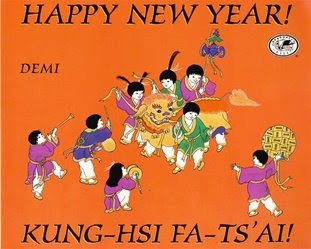
HAPPY NEW YEAR: KUNG-HIS FA-TS’AI!
Written & illustrated by Demi
Dragonfly/Crown, 1997


Each double-page spread in Happy New Year provides information about some aspect, tradition, or foods associated with the celebration and observance of Chinese New Year. The holiday topics Demi writes about include: the animal zodiac, decorating with poems, special foods and their symbolic meanings, firecrackers, heavenly beings, gift giving, lion dances, and lantern festival. Most sections include just a brief paragraph or two of text. Demi’s book is a good introduction to Chinese New Year for children and adults alike.


CELEBRATING CHINESE NEW YEAR
Written by Diane Hoyt-Goldsmith
Photographs by Lawrence Migdale
Holiday House, 1998


This nonfiction book gives readers a glimpse of a contemporary Chinese boy named Ryan and his family preparing for and celebrating Chinese New Year in San Francisco. It provides an historical perspective of the holiday, touches on the immigration of Chinese people to America in the 1850s, shows Ryan and other children learning about calligraphy at a Chinese school, and talks about many of the holiday traditions that have been handed down through the years. The book also talks about one of the most important parts of Chinese New Year—honoring one’s ancestors.
In the photographs, we observe Ryan and his father shopping in the open markets of Chinatown, visiting the cemetery where his grandparents are buried, and preparing special holiday dishes. We also see Ryan and his extended family partaking of the New Year’s feast, Ryan preparing the family altar, and scenes from the lion dance and New Year’s parade in Chinatown.

Celebrating Chinese New Year provides readers a more personal look at this holiday and its traditions as we see it observed and celebrated by an actual Chinese American family—Raymond and Karen Leong, their children, and other relatives.

The book includes a glossary and an index


Book Lists

********************

Reviews of Children’s Books from Wild Rose Reader


********************

Crafts, Activities, & Resources

Thursday, December 18, 2008

Picture Book Reviews: Winter Trees, Christmas Trees


WINTER TREES
Written by Carole Gerber
Illustrated by Leslie Evans
Charlesbridge, 2008


This is a treasure of a nonfiction book written in verse. The rhyming text introduces young children to the different shapes of the crowns of deciduous trees once they are bare of leaves—

the egg shape of the maple tree;
the taller oval of the beech…
The V formation of the birch;
the yellow poplar, wide and high;
the spreading structure of the oak,
its branches reaching toward the sky.


Gerber also writes about the bark and buds and other characteristics of different trees: The American beech’s bark is smooth and silver-gray; the yellow poplar’s is furrowed. The sugar maple’s buds are stout and have clawlike tips; the poplar’s reddish twigs hold puffy buds. She writes, too, about evergreens and how they keep their needles throughout the year. The back matter includes three paragraphs with further information about trees and small illustrations of the seven trees written about in the book.

The spare illustrations created from linoleum block print, watercolor, and collage, are a fine complement to the text. The pictures are set mostly against a plain white or pale blue background. Evans focuses the reader’s eye on the shapes of the trees, the leaves, the buds, the bark—whatever is the main point of each page of text. This helps to enhance the information that is conveyed through Gerber’s verse.

Winter Trees would make a great read-aloud for children in Pre-K through the early elementary grades. It’s an excellent book for young naturalists and one that encourages kids to observe nature more closely.

Click here to view illustrations from Winter Trees.

More Blog Reviews of Winter Trees

7-Imp’s 7 Kicks #93: Featuring Leslie Evans (This post includes images of a number of illustrations from the book.)

From Check It Out: Nonfiction Monday: Winter Trees


CHRISTMAS TREE FARM
Written by
Ann Purmell
Illustrated by Jill Weber
Holiday House, 2006


This is a “realistic fiction” picture book that tells all about the planting, pruning, and care of evergreens on a farm where Christmas trees are raised as the cash crop. The story is narrated by a young boy who explains how his Grandpa and the rest of his family go about their work on the farm throughout the year. The boy also informs readers about the measuring and tagging of trees before they are cut down and brought to the Tree Hut to be sold. Christmas Tree Farm is also a book about a family working together. The story closes with a slew of relatives coming to Grandpa’s and Grandma’s house for a tree trimming party. Weber’s gouache and acrylic naïve-style illustrations are colorful and an appropriate complement to a story narrated by a young boy.


The back matter of the book includes information under the following headings: Christmas Tree Lore, Christmas Tree Facts, and a Christmas Tree Time Line—as well as a two-page spread with labeled illustrations of different types of evergreen trees: Colorado Blue Spruce, Fraser Fir, Virginia Pine, Scotch Pine, Norway Spruce, White Pine, Balsam Fir, and Douglas Fir.

Click here for the teacher packet for Christmas Tree Farm.


HENRY BEAR’S CHRISTMAS
Written & illustrated by David McPhail
Atheneum, 2003


Henry Bear enjoys everything about Christmas: the presents, the jelly cakes Momma Bear always bakes, the warmth and good cheer of the holiday season. But what Henry loves most of all is having a fine, full, beautifully decorated Christmas tree and good friends all around. This story tells about Henry’s search for a Christmas tree. When Henry and his best friend Stanley find the perfect tree at the church, the vicar tells them that it’s not for sale. The tree is going to be raffled off. So what does Henry Bear do? Why, he spends all his Christmas tree money on raffle tickets. He feels certain he’ll win the tree. Unfortunately, on the day of the raffle drawing, Henry Bear isn’t present when his winning number is picked. He’s at the doughnut shop warming himself with a steaming mug of cocoa. Henry ends up having to settle for a brown-needled, scrawny tree that no one wants. After looking over the tree more carefully, Henry observes: “I see that it is not such a bad little tree after all.” Christmas ends up a happy occasion for Henry, Stanley, and Momma Bear. In the book’s final illustration, we see Momma Bear, Stanley, and Henry celebrating the holiday by a glowing fire. This book is another charmer from the talented McPhail.


NIGHT TREE
Written by Eve Bunting
Illustrated by Ted Rand


This is a cozy story about a family (father, mother, son, and daughter) going out on Christmas Eve to decorate a tree in the forest with holiday treats for wild animals: apples and tangerines and balls of sunflower seeds pressed with millet and honey. Beneath the tree the family scatters shelled nuts, breadcrumbs, and pieces of apple for “the little creatures who can’t climb very well.” When the family is finished, they spread out a blanket, open a thermos of hot chocolate, sing songs, and admire their handiwork. This story is told from the perspective of the son who conveys the excitement he feels sharing this annual tradition with his family in the forest and the wonder of this special night as he lies awake in bed. Ted Rand’s realistic watercolor illustrations transport us to a winter forest. The royal blue sky aglow with a full moon adds warmth to the scenery and the changing perspectives help bring the story alive on the pages.


APPLE TREE CHRISTMAS
Written & illustrated by
Trinka Hakes Noble


Published nearly a quarter century ago, Apple Tree Christmas is still in print today. It’s a book I used to read aloud to my elementary students every December.

The book is set on a farm in the late 19th century. This is a warm family story about a mother, father, and two young daughters named Katrina and Josie. It’s also about an apple tree overgrown with wild grape vines that stood near their barn. It was a special tree to the girls. Josie loved to sit on the swing her father had fashioned from the tree’s vines—and Katrina, the artist, sat on a limb that made a perfect drawing board. “She called it her studio.”

One night a ferocious blizzard howls through the farm. Katrina and Josie learn to their dismay that their special apple tree has been felled by the storm. In the days before Christmas, Katrina finds it difficult to concentrate on knitting papa’s presents. She’s disturbed by the sound of her father’s sawing and hacking away at her beloved tree. But what Katrina and Josie don’t know is that Papa isn’t just chopping firewood—he’s making presents for his daughters from the vines and limbs of the tree. On Christmas morning, this is what the girls awake to find:

There, hanging from the beam, was Josie’s swing, the very same swing from the apple tree. Sitting on the swing was a little rag doll that mama had made.

Near the swing was a drawing board made from the very same limb that had been Katrina’s studio. On the drawing board were real charcoal paper and three sticks of willow charcoal.

Noble’s homey, period-style art suit this story of country life in bygone times.


Click here to see illustrations from Apple Tree Christmas at Noble’s website.


More Picture Books about Christmas Trees


Click here to read my review of A City Christmas Tree.


Click here to read my reviews of Merry Christmas, Merry Crow and Mr. Willoughby's Christmas Tree at Blue Rose Girls.


Click here to read my review of Wendell and Florence Minor’s Christmas Tree!.

Thursday, October 30, 2008

Bone Soup: A Great Halloween Read-Aloud


BONE SOUP
Written & illustrated by Cambria Evans
Houghton Mifflin, 2008

When I was an elementary school teacher and a school librarian, I was always on the lookout for picture books to read aloud in my classroom or in the library in October. My students loved it when I turned off the overhead lights, switched on the electric jack-o’-lanterns, and began reading spooky or creepy tales to them. Here’s a review of Bone Soup, a book I recommend for reading aloud on Halloween.

Bone Soup is a retelling of the traditional tale Stone Soup--but this version is set on Halloween--and is replete with all manner of creatures, including zombies and a witch.

The Story: The main character, a ghoulish figure named Finnigin, is known far and wide for his ravenous appetite. Finnigin, a vagabond with no family or home, lives by his wits. Everywhere he goes, he takes along with him three things: his eating stool, his eating spoon, and his enormous eating mouth.

One Halloween, Finnigin sets off for a new town. He hopes that he’ll be invited to take part in the great feast. But a witch sees him on route, heads back to town, and warns the beast that “The Eater” is coming. Word spreads--and soon the zombies and mummy and all the creatures of the village are “talking about the impending arrival of Finnigin the Eater.” In a trice, the villagers stash their edibles:

In a panic, the witch booby-trapped
her jars of eyeballs,
the beast locked his bat wings in a cupboard,
the zombies put their frogs legs in the cellar,
and the mummy and other towns-
creatures hid all they had to eat.


The rest of the tale follows the storyline of the traditional tale. Finnigin knocks on doors and windows and requests food. Time and again he is told by village creatures there is no food. Undaunted, Finnigin makes a fire, fills the largest town cauldron with water, and sets it to boil. Then, he ceremoniously opens his cloak and pulls “out a magnificent piece of bone” and drops it into the cauldron. While stirring his bubbling concoction, Finnigin sings:

BONE SOUP
IS WHAT I MAKE

A MAGIC BONE
IS ALL IT TAKES

BOIL IT LONG AND
ADD SOME SPICE

BONE SOUP TASTES
SO VERY NICE!


The townspeople are intrigued. One by one, they open their doors and head toward Finnigin and his pot of soup. And, one by one, Finnigin tricks the villagers into adding their tasty edibles to the pot: stewed eyeballs, bat wings, frog legs, etc. There’s a fabulous double-page, close-up spread of the gross greenish concoction floating with the aforementioned ingredients. In addition, there are spider eggs, dried mouse droppings, dandelions, and toenail clippings--all labeled for the reader lest he/she wonder what else is being stirred about in the cauldron. Of course, the villagers all concur that Finnigin’s bone soup is a hit.

Once the Halloween feast is over, Finnigin sets off again with his eating stool, his eating spoon….and his gigantic smiling mouth.


The Illustrations: Cambria Evans chose just the right palette for her tale set on the last night of October. Grays, browns, black, and ghoulish green provide a spooky atmosphere. Evans also added just the right touches of pink, yellow, and other colors for contrast. Her round-faced creatures aren’t really frightening--but just Halloweeny enough to send delightful shivers down the spines of young children who are sure to enjoy this new take on a familiar old tale.

Monday, October 6, 2008

A Pumpkin Year


It's that pumpkin time of year! I have reviews of two picture books and links to pumpkin crafts and activities for you.

PUMPKIN CIRCLE: THE STORY OF A GARDEN
Story by George Levenson
Photographs by Shmuel Thaler
Tricycle Press, 1999


Pumpkin Circle is a fine nonfiction book to read aloud to children in kindergarten through the early elementary grades. This book clearly conveys information about the life cycle of a pumpkin from seed into a fully matured fruit to decaying jack-o’-lantern to seedling through photography. Thaler’s close-up photographs of pumpkin seeds, seedlings, roots, leaves, tendrils, buds, flowers, and rind are exceptional. The spare text is at the same time factual and lyrical. Although the book may have read better had the author not tried to rhyme the text, there is still much to commend in Levenson’s writing.

The first page of the book:

Deep
within
each
pumpkin
the air
is damp
and cool.
The walls
are
lined
with
teardrop seeds,
each one
a slippery jewel.


From a description of the plant’s leaves:

Huge green leaves grow toward the sky,
prickly,
lush,
and
wide.


The plant’s “flower buds appear/with pointy little collars and gleaming silver hair.”

Pumpkin Circle isn’t a typical nonfiction book. The text reads like a book-length poem, albeit with imperfect rhymes. Still, I think, it lends itself well to reading aloud to young children--and to introducing them to figurative language. For sure, even the youngest non-readers could learn much about the life cycle of a pumpkin just from browsing through the book and looking at Thaler’s photographs.


PUMPKIN JACK
Written & illustrated by Will Hubbell
Albert Whitman, 2000


Pumpkin Jack is a title that I would describe as a “realistic fiction” picture book. The book’s story explains the life cycle of a pumpkin--but this tale starts with the decomposition of a jack-o’-lantern named Jack--one carved by a young boy named Tim.

After Halloween, Tim takes Jack outside and leaves him in the garden. After a time, Tim notices that Jack is beginning to shrivel. Then he sees that mold has spread over Jack's “bright orange skin.” Jack grows flatter and flatter…and then is cloaked beneath a layer of snow. Winter passes, March arrives, and the snow melts. Tim observes that there is little left of the pumpkin--just crumpled skin, a stem, and a few seeds. Tim scrapes a layer of dirt over Jack.

But when spring turns “barefoot warm, a tiny seedling appeared where Jack had been.” Sure enough, one of the pumpkin’s seeds has sprouted. Tim weeds and waters the plant and watches it grow from a sprout to a “web of vines.” Days grow warmer still--and flowers appear on the pumpkin plant: “Flowers opened on the plant each morning, yellow stars that twisted shut forever in the afternoon.”

In time, Tim finds “a little green ball growing behind a crumpled blossom.” He’s excited. The pumpkin plant continues to grow. Then, one October morning, Tim awakes to see frost coating plants in the garden. Upon his return from school that day, Tim searches through “the withered leaves for the unripe pumpkins.” He picks them and puts them on his front porch. By the end of October, the pumpkins have ripened. Tim gives all but one of them away. He carves the one he keeps…another pumpkin he calls Jack. A year has come full circle.

Hubbell’s illustrations done in colored pencil with solvent washes are colorful, effective, and strongly support the realistic tone of this nature-themed story about decomposition and rebirth.

Pumpkin Crafts & Activities

From Scholastic: Observing the Pumpkin Cycle

From Kaboose: Pumpkin Crafts.

From About.com: Free Pumpkin Carving Patterns

From Scholastic: Pumpkin Seed Estimation & Pumpkin Science Photograph Book

From Education World: Pump Up the Curriculum with Pumpkins!

From Enchanted Learning:
********************
Anastasia Suen has the Nonfiction Monday Round-up at Picture Book of the Day.