Showing posts with label Joyce Sidman. Show all posts

Friday, September 10, 2010

Book Review: Dark Emperor and Other Poems of the Night by Joyce Sidman

Dark Emperor and Other Poems of the Night
Written by Joyce Sidman
Illustrated by Rick Allen
Houghton Mifflin 2010


Well, Joyce Sidman has done it again! She has written another topnotch collection of nature poems. This time her focus is on the flora and fauna of the woods. This time she examines her subjects through the lens of night. She brings the dark forest to life with her words and imagery. In her poems, Sidman illuminates the nocturnal actions of the snail, primrose moth, great horned owl, orb spider, baby porcupette, cricket, oak tree, mushrooms, eft, tree bat—and provides insight into the moon’s thinking. Dark Emperor is a "must have" book for teachers who enjoy connecting science with poetry/literature--and for kids who are budding naturalists!

Joyce Sidman explains how this book started . . .

I used to be just the teensiest bit afraid of the dark. I loved the concept of the nighttime, its mystery and dark beauty, but the reality was a different story. For us humans—diurnal, sight-oriented creatures that we are—the darkness is alien and forbidding, especially in the woods (which already have dark, mythic undertones). But there are all sorts of creatures that prefer the dark, that thrive in the dark. Why? And how? This book is my exploration of those questions. And you know what? Now that I know so much about these fascinating night creatures, I'm not as afraid of the dark anymore!


Welcome to the Night

Welcome to the Night, the first poem in the collection, is a poem of address. In it, Sidman speaks to woodland creatures and invites them to immerse themselves in their habitat and to use their senses to experience their world after dark:

Come feel the cool and shadowed breeze,
come smell your way among the trees,
come touch rough bark and leathered leaves:
Welcome to the night.


To be sure, Sidman is also welcoming readers to immerse themselves in her poems. She takes readers on a sensory field trip. We experience night in the woods along with the flora and fauna. Sidman even has certain animals, an oak tree, and the moon relate their poetic tales in their own voices.

A young porcupine describes its life after the sun has set:

From I Am a Baby Porcupette

I am a baby porcupette.
I cannot climb up branches yet.
While mom sleeps in the trees I curl
beneath a log till sun has set.

I am a baby porcupette.
I nibble in the nighttime wet:
a sprig of leaves, a tuft of grass,
in hidden spots I won’t forget.


In Cricket Speaks, the winged insect expresses its desire to sing “till the branches tremble/and life/swells/to a single/searing/unstoppable/ sound” when midnight—the trilling hour—arrives.

In Oak after Dark, a tree describes how it carries on its business when most may think it’s merely resting:

As nighttime rustles at my knee,
I stand in silent gravity

and quietly continue chores
of feeding leaves and sealing pores.

While beetles whisper in my bark,
while warblers roost in branches dark,

I stretch my roots into the hill
and slowly, slowly, drink my fill.


In Dark Emperor, a small creature (a mouse) beseeches a great-horned owl to let it be: “O Dark Emperor/of hooked face and/hungry eye: turn that/awful beak away/from me; disregard/the tiny hiccup/of my heart/as I flee.”


Sidman is most adept at incorporating poetic devices and figures of speech and of using language in creative ways in her work. One example: She employs repetition to great effect in a number of her poems. In The Mushrooms Come, she uses it to reinforce how the ubiquitous mushrooms spring from many different places in the forest—moss, loam, crumbling logs, musty leaves—and to help capture a soft and fluid rhythm.


From The Mushrooms Come

Unbuttoning the forest floor,
the mushrooms come,
the mushrooms come.

Like noses pink
in midnight air,
like giants’ ears,
like elfin air,
like ancient cities
built on cliffs,
the mushrooms come,
the mushrooms come.

Each two-page spread in the book contains a poem, an elegantly written informative paragraph about the subject of the poem, and large and small linocuts. The book also includes a glossary that explains such terms as echolocation, stridulation, and omnivorous.

About the Art: Rick Allen uses muted colors and abundant black lines in his illustrations to capture the forest after dark. His pictures draw readers into the woods…into the night…and into the nocturnal goings-on of animals and plants.

(Note: I think kids would really enjoy examining Allen’s illustrations to find all the animals he's included in them that are not clearly visible at a glance.)

Rick Allen informed me that he “never tired of her [Sidman’s] words over the eighteen months or so that we worked on the book.” That’s evident. Allen’s illustrations are perfect companions for Sidman’s words. Both poetry and art enlighten and shed light on a dark world that most of us are unfamiliar with.


**********

I asked Joyce if she come tell me more about Dark Emperor. Here’s what she wrote:

Dark Emperor is part of an original "trilogy" of books I wanted to write, about different ecosystems. Water Boatman was the first (pond), Butterfly Eyes was the second (meadow), and this is the third (woods). I can't really remember when I decided to set it in the night time. It was fascinating to learn how different organisms cope with, and thrive in, darkness. As always, I learned a lot as I researched and wrote the book. One other tidbit: "Ballad of the Wandering Eft" was written to the tune of "Dark as a Dungeon" by Merle Travis. I'm hoping at some point some kid will perform it on You Tube and I can listen!

Good news for Joyce Sidman fans: Joyce and Beth Krommes are working on a picture book for younger children called Swirl by Swirl: Spirals in Nature, that will come out in fall of 2011!

Note: I would like to thank Joyce Sidman for providing me with information about Dark Emperor and for the news about her next book. I also want to thank Rick Allen for his quick response to my request for images of illustrations from the book.

**********

Dark Emperor Book Trailer


Dark Emperor Reader’s Guide
**********

At Blue Rose Girls, I have a poem by Wislawa Szymborska titled Photograph from September 11.
Anastasia Suen has the Poetry Friday Roundup at Picture Book of the Day.

Tuesday, April 27, 2010

UBIQUITOUS by Joyce Sidman & Beckie Prange: A Poetry Book Review


Poetry and science are two of my passions. When I was an elementary teacher, I loved connecting poetry with the different science units I taught. I was always looking for poems to integrate with my units on trees and soils, astronomy, animals, and the life cycle of butterflies. I suppose that’s one of the reasons why Joyce Sidman is one of my favorite children’s poets. She is able to weave her knowledge of nature and science seamlessly into her extraordinary poetry.
I was thrilled when I heard that Joyce was publishing a collection entitled Ubiquitous: Celebrating Nature’s Survivors this year—especially after I watched the trailer for the book.


Ubiquitous: Celebrating Nature’s Survivors
Written by Joyce Sidman
Illustrated by
Beckie Prange
Houghton Mifflin, 2010


Joyce Sidman explains how her book Ubiquitous started at her Web site:

My sister is a biologist who works with insects. One day, on an impromptu nature walk, she snagged a beetle, held it in her hand, and remarked about how successful beetles are--how many species there are in the world. She went on to explain that they had mutated from flies; their forewings had become hardened and armored, allowing them to survive better than flies under extreme conditions. This discussion started me thinking about what allows one group of organisms to stick it out here on earth, while others become extinct. Boy, was it ever interesting to find out! I did more research for this book than any other; but I learned more, too--I basically ended up studying evolutionary history.


I emailed Joyce to ask if she could give me further information about the book. I wrote: “I also saw in your book's acknowledgments all the different scientists you thanked. I was wondering if you'd care to provide me with any other information about the time it took you to complete this book and/or how much research you had to do in evolutionary history.”

Joyce responded: This book took a long, long time to write, because I really had to feel my way. I am not a scientist, and the further I dug into research, the more science seemed to be involved. I started thinking about the idea about eight years ago. I thought it would be fun to find lots of "survivor" organisms to write about, and eagerly listed a whole bunch of them to explore. Then, as I delved deeper into research, I realized that organisms survive for all different kinds of reasons, some of them having to do with disruption by man. In fact, because I didn't want this to be a book about "urban" animals, I deleted poems I'd written about Canada Geese, kudzu (an invasive vine), and pigeons. I wanted to choose organisms that had developed survival mechanisms long before humans showed up. So I went slowly, making sure I was following the right paths, checking in with my biologist sister every once in a while for her comments. Sometimes I put away the book and worked on other things.

Then I decided to group my chosen organisms according to evolutionary history, and that opened another can of worms. My brain was sorely strained by trying to keep all my epochs straight! I bought a big chart called "A Correlated History of Earth" and hung it on my wall.

Beckie went through similar efforts to achieve dynamic yet accurate illustrations. We went back and forth on many facts, and she spent a tremendous amount of time on the timeline. She also caught some math errors of mine (thank goodness!) when I was translating inches into centimeters in the nonfiction notes. I am thrilled with her vividly beautiful artwork, which is similar to, and yet so different from, Song of the Water Boatman. The book is everything I'd hoped it would be.


The book is also everything I hoped it would be. And more!


Although the Ubiquitous may seem a slim collection with just fourteen poems—it is a substantial book. It takes readers from BACTERIA, the first form of life that appeared on our planet over three billion years ago to HUMANS—who appeared very late in earth’s history. In between the poems about bacteria and Homo sapiens, readers will find poems and paragraphs of factual information about the following plants and animals:
Mollusks
Lichens
Sharks
Beetles
Diatoms
Geckos
Ants
Grasses
Squirrels
Crows
Dandelions
Coyotes


Joyce Sidman has a talent for selecting the best type of poem to express her ideas about a particular subject—be it a pantoum, a diamante, a mask poem, a poem of address, or a shape poem. To my delight, five of the poems in Ubiquitous are mask poems—which I love. Lichens, a scarab beetle, grass, squirrels, and coyotes all speak to us in their own voices. Coyotes extend an invitation to readers. Their three-stanza poem ends with the following four lines:

Come, come with us!
Come kindle the blue twilight.
Come croon in the wild chorus,
come vanquish the tranquil night.


Grass explains that it can grow “in places/others can’t/where wind is high/and water scant…on steppe or veld/or pampas dry.”

In Tail Tale, squirrels speak breathlessly about themselves and their lives. (There’s little punctuation in the poem.) Sidman’s squirrels explain what they like about being who they are. Just imagine if you too had a “free fur coat/and the ability to crack any/safe known to man.”
I doubt there are many poets who would attempt to write a poem told from the point of view of the lowly lichen. Well, Joyce did—and the poem is a gem!

The Lichen We
(after Siegfried Sassoon’s “Man and Dog”)

Who’s this—alone with stone and sea?
It’s just the lowly Lichen We:
the alga I, the fungus me;
together blooming quietly.

What do we share—we two together?
A brave indifference to the weather.
A slow but steady growing pace.
Resemblance to both mud and lace.

As we are now, so we shall be
(if air is clear and water free):
the proud but lowly Lichen We
cemented for eternity.


A detail from Prange's illustration of lichens:

Sidman also includes two excellent poems of address in Ubiquitous. She speaks to a shell in The Mollusk That Made You. The poem begins:

Shell of the sunrise,
sunrise shell.
yours is the pink lip
of a pearled world.

Who swirled your whorls and ridges?


She also interrogates a crow:

What secret orders were you given?
What deeds to do? What plots to thicken?

There are questions in some of the other poems, too, that give readers pause for thought.


Sidman’s poetry about the beginnings of life on Earth…about plants and animals that are survivors who exist here today...both enlightens and engages the reader. It speaks to the wonder of it all. Her prose paragraphs are clearly and concisely written—and contain lots of interesting information.

Beckie Prange’s exceptional hand-colored linocuts serve as the perfect backdrop for Sidman’s poems. They aren’t merely there as decoration. They are an integral part of the book—complementing, supporting, and expanding upon scientific information included in the text. Prange depicts lichens at seven times their life size, provides a close-up look of tiny diatoms as they might appear under a microscope, and illustrates the different stages in the life cycle of beetles. She also gives us a cutaway view of an underground ant colony. This collection is definitely a wonderful marriage of poetry and art…and science!

Ubiquitous gives readers an eloquently condensed and illuminating history of life on planet Earth. I give it my highest recommendation!!!!!

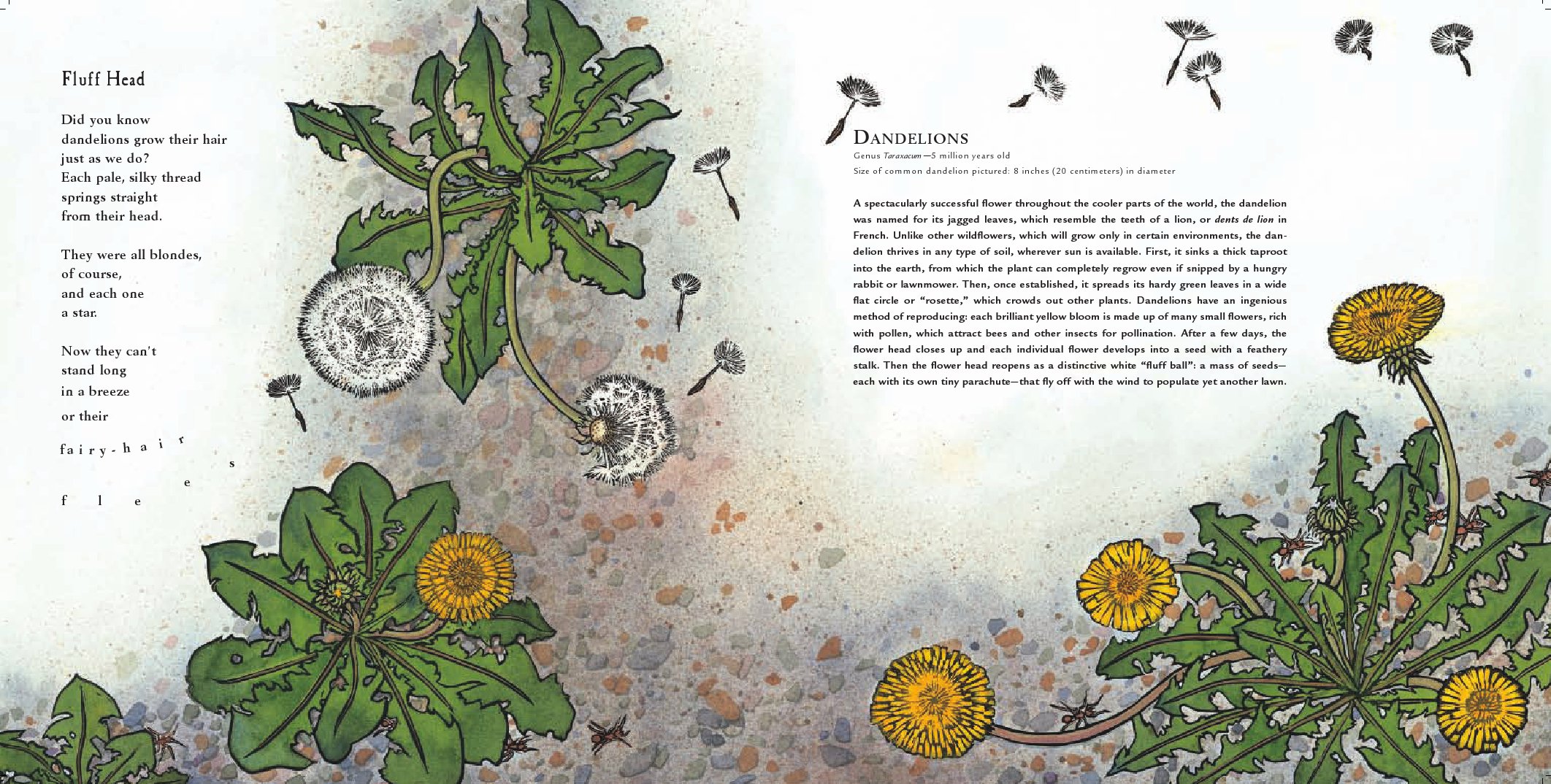
Click here to view a two-page spread about the dandelion from the book.

Click here to read It’s a Long Story: Joyce Sidman’s Ubiquitous celebrates evolution’s winners (article by Rick Margolis—School Library Journal, 4/1/2010)


Beckie Prange Ubiquitous Prints
Giclee prints of Beckie Prange’s illustrations in Ubiquitous are available for purchase at her site. Click here to see them.


Learn More about Joyce Sidman

  • Cybils Interview with Joyce Sidman (Interview by Kelly Fineman, 2/20/2007)
  • Click here to read Jules’s recent interview with Joyce Sidman at Seven Impossible Things.
  • Click here to read all my Wild Rose Reader posts about Joyce Sidman and her poetry books.

Thursday, April 16, 2009

Red Sings from Treetops: A Book Review & An Invitation

Red Sings from Treetops: A Year in Colors
Written by Joyce Sidman
Illustrated by Pamela Zagarenski
Houghton Mifflin, 2009
A Little Background about How the Book Started
Here’s an excerpt from the interview I did with Joyce Sidman last year.

Elaine: You told me before that your most recent book, This Is Just to Say, came out of your work as a writer-in-residence—that it came pouring out of you in a way that other books haven’t. How long does it usually take for you to write a collection of poems? What is the process like?

Joyce: Well, it’s different for every book, but generally I start with an idea, or an image, or an emotion. I have a book coming out next year called Red Sings from Treetops—it’s about color in nature. This book started with the deep thrill that color gives me: a flaming red maple or the soft green of new buds. But an emotion or image is not enough—I have to figure out a “voice” for the book: a way to write it so that it captures that original emotion. I played around with all sorts of color poems, touching on this idea or that, and then retreating when it didn’t feel right. This happened over the course of a year. Finally one spring I looked down at some tracks in the mud, and a line came into my head: “Look down—brown. Deer were here, and a dainty raccoon.” That line isn’t even in the book anymore, but I knew that I’d found a way in, a way of talking about color as though it were alive. After that, the book took about three months to write and another few months of tinkering. I have to go slowly. If I force it, it’s just bad poetry. And I have to give it time to rest so I can look at it with fresh eyes and see if it still works.

From Joyce Sidman’s website: Color has always had the power to lift my spirits and thrill me. The first time I saw a cardinal on top of a tall tree, singing his heart out in the late winter sun, I thought, "WOW!" On my daily walks, I started looking for color everywhere, in each season. And it WAS everywhere--even in winter. To me, each color seemed like an old friend come alive somehow. This book is my attempt to bring color to life for others, as well.


About the Book
Those of us who know and love Joyce Sidman’s poetry books appreciate all the "tinkering" she does with her poems and all the time she gives them to rest so she can revisit them with “fresh eyes.” Sidman’s poetry for children is exceptional.

I’m happy to say that her newest book is no exception to the “exceptional” standard she set for herself in creating outstanding collections of poetry in the past. In Red Sings from Treetops, she gives readers insight into colors through her novel approach to writing about them. Sidman takes a seasonal look at BLUE and YELLOW and RED and GREEN and other colors—and shows us what they embody during different times of the year. For example, here’s what she writes about the pink of spring and the pink of winter:

SPRING

And here,
in secret places,
peeps Pink:
hairless,
featherless,
the color of
new
things.


WINTER

In the WINTER dawn,
Pink blooms
powder-soft
Over pastel hills.

Pink prickles:
warm fingers
against cold cheeks.

To Sidman, in summer Yellow melts/everything it touches…/smells like butter,/tastes like salt. But in fall, Yellow is a school bus that grows wheels/and lumbers/down the block,/blinking:/Warning—classrooms ahead.

Sidman’s colors are alive. They move and sing and whisper and float and drip and breathe. In spring, RED squirms on the road after rain. PURPLE pours into summer evenings one shadow at a time. BROWN rustles and whispers underfoot in fall. In winter, GREEN waits in the hearts of trees, feeling the earth turn.

This is what the best poetry should do: Help us to look at common subjects with new eyes—help us to appreciate what lies beneath the surface—to see the reality of something as perceived in one’s imagination. Sidman thinks through the “layers” of colors in this collection and introduces us to their varied personalities.

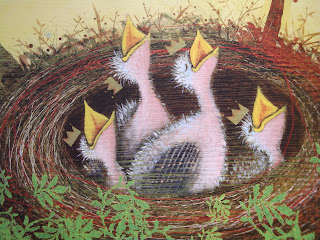
Pamela Zagarenski’s art is the perfect complement for Sidman’s text. Her mixed media illustrations are stunning—and, like the poems, draw us into the seasonal lives of colors. Some pictures burst with brightness—a brilliant orange pumpkin in autumn…a brazen yellow sun in summer. In other pictures, colors are subdued—like the muted green of winter and pale pink of featherless baby birds in spring.


Write and Share a Color Poem
Last year, when I interviewed Joyce Sidman during National Poetry Month, she and I invited my blog readers to write poems of apology like the ones Joyce had written for her book This Is Just to Say. This year, I asked if she’d like me to invite people to write their own color poems.
Here’s what Joyce wrote:
I love to write color poems with the students I teach in my writer-in-residence weeks at local schools. We try to employ "synesthesia" (see my teacher's guide page: http://www.joycesidman.com/redsingsTG.html) and use all five senses. They really enjoy it, and have definite feelings about certain colors. One beautiful line from a ten-year-old is "Red dances on the sun like a freed slave."

It would be fun to see what your readers could come up with--if you want, you could refer them to the teacher's guide page, and they could write one of the three kinds of color poems I have listed???

Here are a couple of poems that I posted previously at Wild Rose Reader. I didn’t write them as “color” poems—but they both touch on the subject.

Watermelon slice
I sink my teeth in
Savoring succulent flesh
Juice dribbling down my chin
Eating my way down
To a broad green grin

Green carpets the ground,
Reaches over the hills, blankets the broad valley,
And across the wide prairie, stalks of tall golden grain
Sway in the wind
Singing the song of the plain.


NOTE: Poem and artwork from Red Sings from Treetops by Joyce Sidman, illustrated by Pamela Zagarenski. (c) 2009. Used by permission of Houghton Mifflin Harcourt. All rights reserved.

********************
The Poetry Friday Roundup is at Becky’s Book Reviews this week.
At Blue Rose Girls today--POETRY FRIDAY: Opposite Poems
At Political Verses today--Gasbag: A Limbaughrhyme

Saturday, September 6, 2008

This Is Just to Say: A Few More Words about the Poetry Book & Poems of Apology

Sara Lewis Holmes gives us a “sneak preview” of the DC Kidlit Book Club discussion this month at her blog Read Write Believe. The book the club has selected for discussion is the Cybils award winning poetry title This is Just to Say: Poems of Apology and Forgiveness, which was written by Joyce Sidman. (Sara served on the Poetry judging panel.) Sara says: “You can participate virtually in the comments anytime, or if you live near DC, we'd love to have you join us this Sunday.

You can read Sara’s post about the discussion and a take a “sneak peek” at some of the discussion questions here.

This Is Just to Say: Poems of Apology and Forgiveness

by Joyce Sidman


More about This Is Just to Say, Joyce Sidman, & Poems of Apology

  • If you would you like to know more about Sidman’s book, you can read my review of This Is Just to Say: Poems of Apology and Forgiveness here.
  • If you would like to know more about Joyce Sidman and her poetry books, read my interview with her here.
  • If you would like to read some poems of apology written by kidlit bloggers during National Poetry Month this year, read this Wild Rose Reader post.
  • Visit the This is Just to Say page at poet Joyce Sidman’s website where you will find a poem from the book and a link to a reader’s guide, which includes discussion questions, suggested writing exercises, and ideas for creating a class book.